
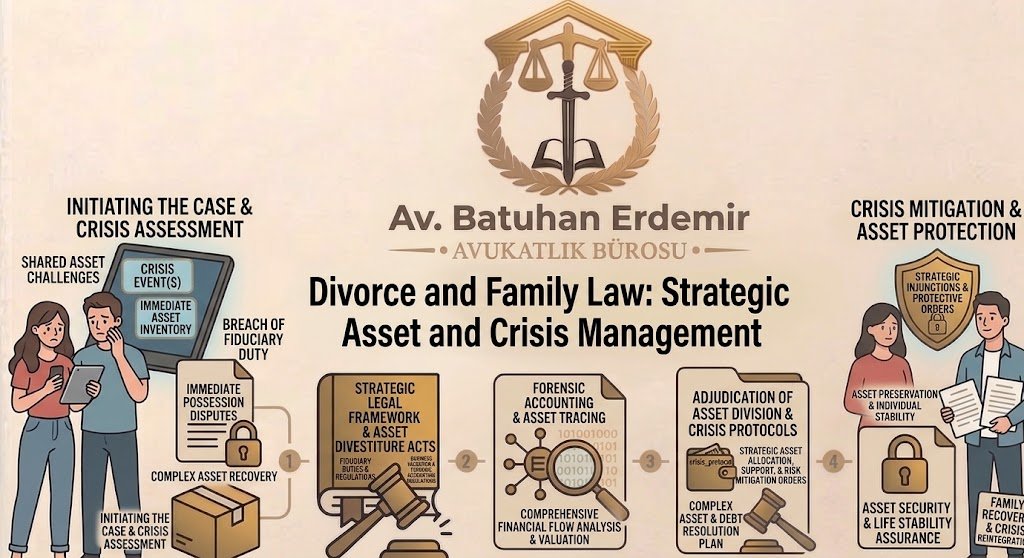
Divorce and Family Law: Strategic Asset and Crisis Management
The institution of marriage is not only the most fundamental social building block of society but also a profound legal contract upon which mutual rights and obligations—such as loyalty, economic partnership, and solidarity—are constructed. The process of terminating this union is not merely an emotional trauma for the individuals involved; it is simultaneously the legal liquidation of intertwined joint assets, commercial company shares, and social status built over the years.
In contested divorce proceedings, the intense anger and psychological devastation experienced by the parties often carry the risk of turning courtrooms into arenas for personal vendettas. However, in the practice of divorce and family law, the primary function is not to provide emotional satisfaction. Rather, it is to determine the material facts (fault) that shook the foundation of the marriage on a rational basis, concluding the process with a fair legal and financial restoration in favor of the client.
Divorce and Family Law: Fault Determination and Evidence
In “severe incompatibility” (irretrievable breakdown of marriage) disputes filed under the Turkish Civil Code No. 4721, the sole element determining the fate of the case and the scale of compensation is the determination of “fault.”
Proving who made the marriage unbearable—and through which actions, such as infidelity, economic abuse, or physical/psychological violence—must rely not on abstract and fictional claims, but on lawful, objective evidence (e.g., HTS records, bank/credit card statements, hotel/travel logs). The “fruit of the poisonous tree” doctrine also applies in family law; any evidence obtained by violating the privacy of personal life (such as spyware, hidden audio, or video recordings) cannot be used as a basis for fault determination. Rational legal defense relies on refuting the opposing party’s fabricated witness testimonies through aggressive cross-examination tactics and objective evidence.
Asset Division and Commercial Company Shares
The dimension of the divorce process with the highest financial volume is the liquidation of the “Participation in Acquired Property Regime,” which applies to marriages post-2002. As a general rule, real estate, vehicles, cash savings in banks, and most importantly, the growth value of commercial company shares acquired by paying a price during the marriage, are subject to a fifty-fifty division.
To prevent asset-hiding attempts (collusive transfers), it is imperative to immediately place a “Preliminary Injunction” (İhtiyati Tedbir) on the title deeds of real estate and company shares as soon as the lawsuit is filed. Bringing hidden assets to light through independent financial advisors and bank/title deed inquiries (active-passive calculations) is the lifeblood of this process.
Child Custody and the Best Interest of the Child
The area where family courts exercise the broadest discretionary power is determining who will be granted custody of the joint children. The unshakeable rule of modern law is that custody is not an absolute property right or a tool for revenge granted to a parent; it is an obligation established entirely to ensure the physical, mental, and pedagogical development of the child.
Before the judicial authorities, the debate is not about which parent is wealthier, but rather the principle of the “best interest of the child,” evaluated in light of Social Investigation Reports (SİR) prepared by expert pedagogues. If there is a risk of violence, restraining orders are immediately obtained under the Law No. 6284 on the Protection of Family. Meanwhile, for the spouse who is not granted custody, a continuous “Establishment of Personal Relationship” (visitation rights) suitable for the child’s age is legally secured.
Compensation Lawsuits and Mutually Agreed Divorce
Material and moral compensation claims in a divorce are not tools for “unjust enrichment.” They serve as the legal restoration of the psychological ruin and economic loss caused by the wrongful actions (e.g., infidelity, violence) of the at-fault spouse. By proving acts of severe fault with forensic police and hospital reports, the highest possible compensation permitted by law is demanded.
To avoid experiencing this exhausting process altogether, the most rational path is to conclude the case in a single hearing by meticulously structuring the elements of custody, alimony, compensation, and asset division into a single “Mutually Agreed Divorce Protocol.” For strategic legal defense of your rights in contested divorce, asset liquidation, and custody cases, you can contact our expert team through the contact section of our website.
Legal Notice and Disclaimer
All articles, analyses, and legal evaluations contained on this website are provided for general informational purposes only and do not, under any circumstances, constitute a formal legal opinion, legal advice, or consultancy intended to be applied to a specific dispute or legal situation.
Due to the dynamic nature of legislation and the unique material characteristics of each concrete case, our firm accepts no liability for any loss of rights that may arise from actions taken or decisions made in reliance upon these texts.
You may contact us directly to have your legal problems resolved, to obtain a professional legal opinion based on your specific case file, or to schedule an appointment for verbal consultancy services.