
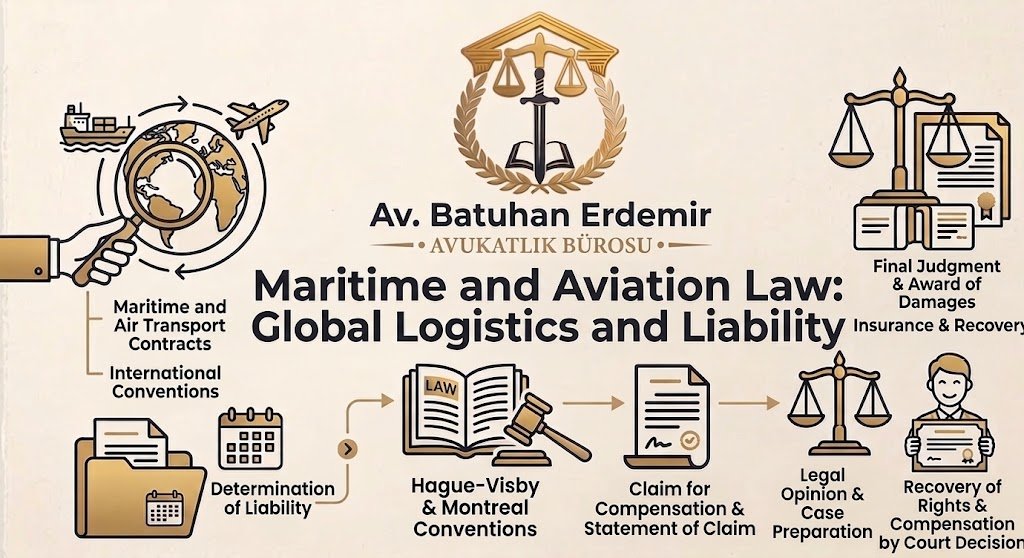
Maritime and Aviation Law: Global Logistics and Liability
Maritime and aviation law constitutes a massive global ecosystem where billions of dollars worth of commercial cargo and human lives are governed by international conventions (Hague-Visby, Warsaw, Montreal) beyond the territorial waters or national airspace of states. Crises occurring within this macro-scale logistics network require a profound and entirely unique (sui generis) legal vision that transcends the narrow confines of classical domestic legal rules.
The most strategic crisis that emerges following a collision on the high seas, marine pollution (environmental disaster), or an aircraft accident in international airspace is the question of jurisdiction: “Who bears the liability, and which country’s law will apply?” In these highly complex disputes—where the vessel’s flag, the shipowner, the cargo owner, and the P&I (Protection and Indemnity) insurance club are domiciled in different jurisdictions—rational legal defense relies on flawlessly interpreting interstate conventions in alignment with commercial interests.
Maritime and Aviation Law: Ship Arrest Procedures
The most operational and time-sensitive procedure in maritime commerce is the “Ship Arrest” mechanism. The grounding or detaining of a massive commercial vessel docked at an international port via a local court order—due to unpaid bunker claims, port dues, salvage fees, seafarers’ wages, or cargo recourse claims—is a catastrophe where every passing second translates into millions of dollars in losses for the shipowner.
In accordance with the “Maritime Commerce” provisions of the Turkish Commercial Code No. 6102 and international treaties, aggressively lifting an unjust arrest to immediately release the vessel (by submitting a bank guarantee or a P&I Club Letter of Undertaking), or placing an urgent arrest on a vessel on behalf of a creditor corporation, is the most highly-stressed judicial intervention in maritime practice.
Aviation Disputes and Breaching SDR Limits
Passenger and cargo transportation disputes in the aviation sector, crossing oceans and continents, are resolved within the framework of the Turkish Civil Aviation Law No. 2920 and the international Montreal Convention, to which Turkey is a signatory.
In cases of loss or delay in air cargo, or accidents in passenger transport, the compensation liability of airlines is restricted by international limits known as “Special Drawing Rights” (SDR). However, piercing this corporate veil of limited liability depends on successfully proving “wilful misconduct” or gross negligence in the carrier’s actions. Through this strategic proof, the applied SDR limits are bypassed, and full compensation processes are initiated for the victims or cargo owners.
General Average, Collisions, and Cross-Border Liability
The technical legal processes executed to protect the interests of corporations, insurers, and shipowners in international sea and air cargo transportation encompass the following stages:
- General Average: The equitable apportionment of extraordinary sacrifices and expenditures intentionally made by the master for the common safety of the ship and cargo (e.g., firefighting or refloating a grounded vessel) between the vessel and cargo owners within the framework of the York-Antwerp Rules.
- Bill of Lading Disputes: In cases of short, damaged, or delayed delivery of cargo; auditing the exemption (immunity) clauses of the carrier, charterer, and insurance companies (recourse claims) under international conventions through technical expert reports.
- Collisions and Environmental Pollution: Determining fault ratios in vessel collisions at sea and conducting high-volume compensation negotiations with international funds and P&I clubs in environmental disasters caused by oil/chemical spills.
- International Occupational Accidents: Overcoming complex jurisdictional rules (forum non conveniens) in severe workplace accidents experienced by seafarers and flight personnel (cabin crew/pilots) in international territories, ensuring lawsuits are filed in the most favorable jurisdictions to secure maximum compensation.
Our fundamental legal vision in this field is to protect corporate capital by activating the universal power of international conventions during cross-border logistics crises. For strategic legal representation regarding ship arrests, bill of lading disputes, aviation compensation, and P&I insurance processes, you can contact our expert legal team through the contact section of our website.
Legal Notice and Disclaimer
All articles, analyses, and legal evaluations contained on this website are provided for general informational purposes only and do not, under any circumstances, constitute a formal legal opinion, legal advice, or consultancy intended to be applied to a specific dispute or legal situation.
Due to the dynamic nature of legislation and the unique material characteristics of each concrete case, our firm accepts no liability for any loss of rights that may arise from actions taken or decisions made in reliance upon these texts.
You may contact us directly to have your legal problems resolved, to obtain a professional legal opinion based on your specific case file, or to schedule an appointment for verbal consultancy services.