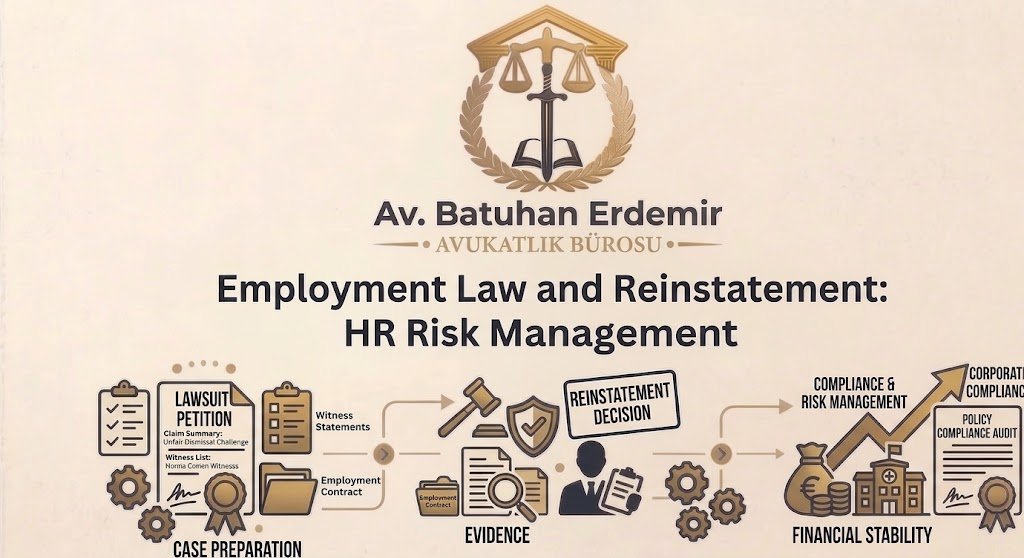
Employment Law and Reinstatement: HR Risk Management
Labor law is inherently designed to balance the power asymmetry between the employer, who holds the means of production (capital), and the employee, who offers their labor to sustain their livelihood. However, in the modern commercial ecosystem, this relationship is no longer solely about the historical dogma of “protecting the weak”; it is equally about ensuring corporate economic survival and preventing malicious claims aimed at unjust enrichment.
At this precise intersection, employment law and reinstatement lawsuits merge the existential crisis of an employee stripped of economic independence with the devastating compensation risks faced by employers due to formal HR procedural errors. The rational mission of jurisprudence here is to protect human labor’s dignity from corporate arbitrariness, while simultaneously rescuing capital from becoming a compensation loophole exploited by orchestrated “hostile witness” testimonies.
C-Level Executive Crises and Non-Compete Clauses in Employment Law and Reinstatement
The classic “employee protection” paradigm completely collapses when dealing with “C-Level” executives such as CEOs, CFOs, or General Managers. Crises between top-tier executives—who make the company’s most strategic decisions and possess all commercial secrets (know-how)—and the board of directors are not ordinary terminations, but multi-sided corporate chess matches.
In high-level separations, the fiercest legal battles are waged over “Non-Compete” and “Non-Disclosure Agreements” (NDAs). Under the Turkish Code of Obligations No. 6098, disproportionate non-compete bans imposed by companies that indefinitely mortgage an executive’s professional future can be annulled by courts. In these sophisticated disputes, protecting the executive’s stock options, proving psychological harassment (mobbing) claims, and managing sectoral reputation require a masterclass in negotiation and litigation strategy.
Workplace Accidents: OHS Negligence and Fault Attribution
The most severe disputes encountered in industrial production and the construction sector are workplace accidents violating an employee’s bodily integrity. A workplace accident is rarely an unforeseeable “destiny”; it is predominantly the mathematical result of a chain of negligence where Occupational Health and Safety (OHS) measures are ignored to reduce costs.
Supreme Court precedents are definitive: An employer’s responsibility does not end with merely providing a hard hat or equipment; they must actively “supervise” its use on the field. Hiding the fact that the fault stemmed from exhaustion or excessive overtime, and illegitimately billing the fatality or disability to the victim (claims of contributory negligence), is unacceptable. In such files, material/moral compensation mechanisms are swiftly executed to penalize the “profit margin greed,” utilizing actuarial expertise to calculate loss of earning capacity.
Malicious Claims, Hostile Witnesses, and Fake Overtime
The flip side of the coin reveals the trap of transforming the employer-employee relationship into a tool for malicious enrichment. It has become a routine reflex for employees who disrupt workplace discipline or commit theft to immediately file standardized lawsuits claiming “mobbing, unjust termination, and 14 hours of continuous daily overtime.”
The primary reason these baseless claims are accepted in courts is the practice of former employees, who have their own ongoing hostility (lawsuits) with the employer, acting as “organized witnesses” for one another. Proving the employer’s innocence depends on presenting digital logs, GPS data, and biometric attendance systems to the court at Forensic IT standards, and dismantling false testimonies through aggressive cross-examination (Preventative HR Law).
Employment Law and Reinstatement Lawsuits: Operational Decisions
Global economic crises or sudden market losses may compel companies to make painful downsizing decisions to survive. A company’s cadre reduction (collective redundancy) to protect its economic existence falls under the freedom of “Operational Decisions” within the Turkish Labor Law No. 4857. It is strictly unlawful for labor courts to conduct an “expediency review” and act like a CEO questioning business judgment.
Nevertheless, the employer must always apply termination as the “Ultima Ratio” (Last Resort). Executing Mutual Termination Agreements (İkale) and mediation mechanisms in accordance with the “reasonable benefit” criterion, instead of unilateral termination, is the only strategic legal shield saving a company from destructive reinstatement penalties amounting to 8 months’ salary per employee.
Whether you are an unjustly terminated employee, a C-Level executive facing character assassination, or a holding company grappling with baseless lawsuits and reinstatement crises, you can contact our expert legal team through the contact section of our website for rational, uncompromising, and strategic legal representation.
Legal Notice and Disclaimer
All articles, analyses, and legal evaluations contained on this website are provided for general informational purposes only and do not, under any circumstances, constitute a formal legal opinion, legal advice, or consultancy intended to be applied to a specific dispute or legal situation.
Due to the dynamic nature of legislation and the unique material characteristics of each concrete case, our firm accepts no liability for any loss of rights that may arise from actions taken or decisions made in reliance upon these texts.
You may contact us directly to have your legal problems resolved, to obtain a professional legal opinion based on your specific case file, or to schedule an appointment for verbal consultancy services.