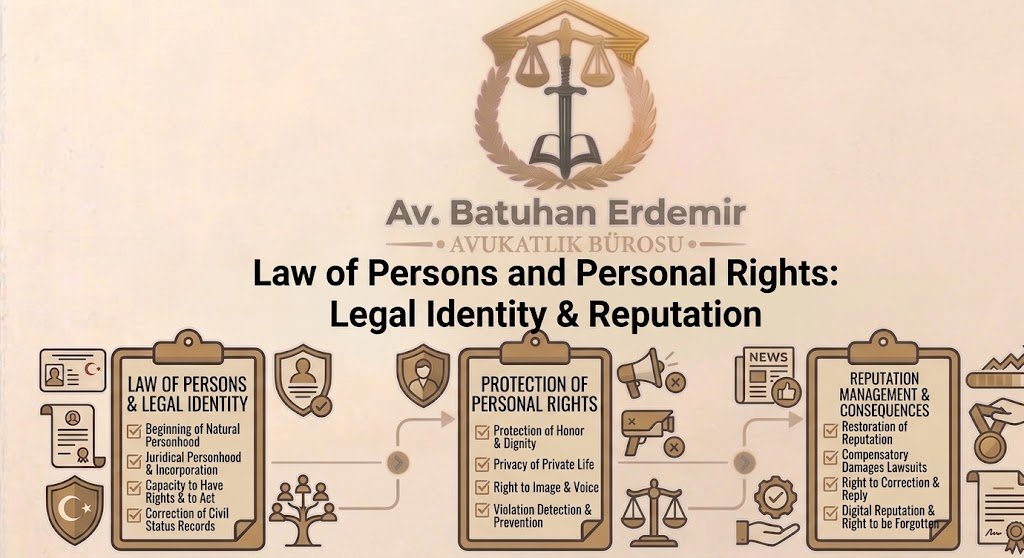
Forming the introductory provisions of civil law, the law of persons and personal rights is the most fundamental legal discipline focusing on the innate legal capacity of human beings and their will to exercise this capacity. An individual’s honor, dignity, bodily integrity, and moral existence are not merely bureaucratic records kept in civil registries; they are constitutional shields rigorously protected by state authority.
However, in today’s digitalized and increasingly complex world, an individual’s legal subjectivity is under severe siege by digital identity thefts, unauthorized data processing, and social media manipulation. Consequently, this field has evolved beyond traditional lawsuits, transforming into a proactive reputation management practice aimed at protecting the individual’s presence in both the physical and digital realms.
Law of Persons and Personal Rights in the Digital Age
The protection of one’s legal persona offers powerful statutory weapons to the victim against any unlawful attack under Article 24 of the Turkish Civil Code No. 4721 (TMK). Our legal system guarantees the right to demand the cessation of an attack, the prevention of an imminent threat, and the declaratory judgment of the attack’s illegality, alongside claims for material and moral compensation.
Especially when an individual’s “right not to be stigmatized” is violated on the internet (social media platforms, news sites, search engine caches) or when they suffer character assassination through baseless defamation, traditional compensation lawsuits that last for years are inherently insufficient.
At this precise juncture, obtaining “content removal” and “access blocking” decisions from Criminal Peace Judgeships within 24 hours, pursuant to the Internet Law No. 5651, is the first and sharpest rule of digital reputation defense.
Guardianship, Trusteeship, and Boundaries of Free Will
The delicate balance between the freedom and the protection needs of individuals who cannot manage their own affairs due to reasons such as mental illness, cognitive weakness, old age (dementia/Alzheimer’s), or severe extravagance constitutes the most sensitive axis of guardianship law. The primary objective of the law here is to protect the individual who has lost their capacity of will, both from themselves and from the outside world.
In practical application, however, attempts to unjustly impose a guardianship (restriction) pressure on someone’s assets, or conversely, the hijacking of vulnerable elderly/disabled individuals’ assets by malicious third parties, are frequently encountered crises. In such scenarios, the contentious judicial processes conducted in Civil Courts and the strict scientific auditing of Forensic Medicine Institute reports are of paramount importance.
Name and Surname Change: The “Just Cause” Criterion
Legally, the name or surname a person carries is not merely a string of data written on an identity card; it is the cornerstone of that individual’s social identity, psychological integrity, and self-esteem. According to Article 27 of the Turkish Civil Code, a name or surname can only be changed based on a “just cause” presented to the judge.
A name being ridiculous, impossible to pronounce, or constantly dragging the individual into social trauma are established as valid reasons by the courts. However, in practice, the legal struggle of those wishing to discard a father’s surname due to family traumas or those suffering a loss of commercial reputation requires a highly strategic evidence-gathering process. This battle fought in courtrooms is the legal registration of an individual freely reconstructing their own identity.
Gender Transition Processes and Legal Registration
One of the most specific judicial processes within this legal framework is the gender transition procedures undertaken by transgender individuals and the “gender reassignment permission” lawsuits filed under Article 40 of the TMK. Obtaining permission from the court regarding the incongruence between an individual’s psychological identity and their physical body is one of life’s most critical bureaucratic and medical thresholds.
Following health board reports, psychiatric approvals, and mandatory medical procedures, amending civil registry records (the hidden digits behind the Turkish ID number) is the only way for the individual to exist socially and legally with their true identity. The defense undertaken in these cases is not just a name or gender registration; it is the legalization of the individual’s constitutionally guaranteed right to develop their material and moral existence.
For strategic representation in access blocking against digital attacks, name/surname change lawsuits, appointment of guardians, or gender transition legal procedures, you can contact us through the contact section of our website.
Legal Notice and Disclaimer
All articles, analyses, and legal evaluations contained on this website are provided for general informational purposes only and do not, under any circumstances, constitute a formal legal opinion, legal advice, or consultancy intended to be applied to a specific dispute or legal situation.
Due to the dynamic nature of legislation and the unique material characteristics of each concrete case, our firm accepts no liability for any loss of rights that may arise from actions taken or decisions made in reliance upon these texts.
You may contact us directly to have your legal problems resolved, to obtain a professional legal opinion based on your specific case file, or to schedule an appointment for verbal consultancy services.