
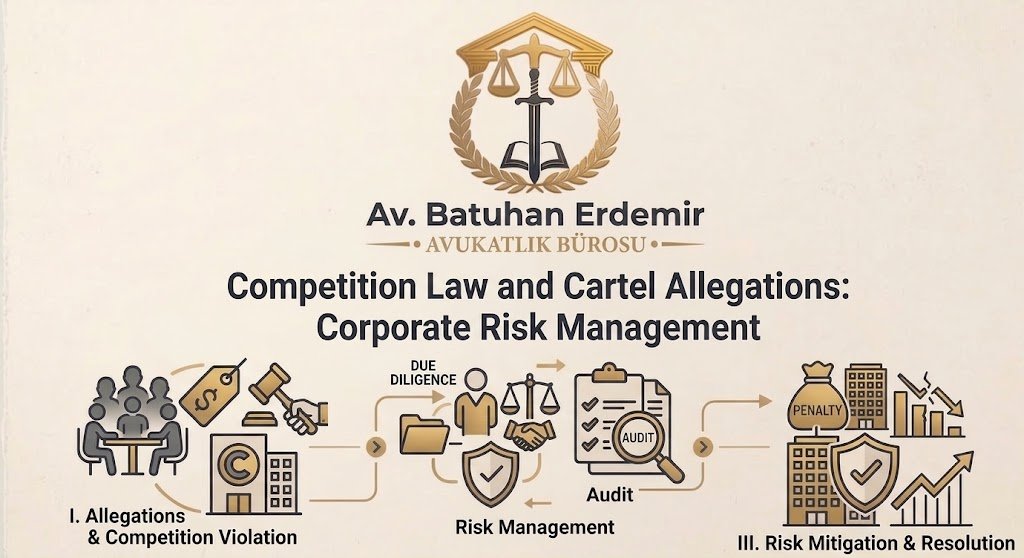
Competition Law and Cartel Allegations: Corporate Risk Management
Acting as the constitution of the free market economy, the Law No. 4054 on the Protection of Competition grants the Turkish Competition Authority (TCA) immense auditing and sanctioning powers to prevent actions by undertakings that distort market dynamics. The administrative fines imposed by the Authority can reach up to ten percent (10%) of a company’s annual gross revenue—astronomical figures capable of deeply shaking even global-scale multinational corporations.
Investigations initiated on the grounds of abuse of a dominant position, price-fixing agreements, territory/customer allocation, or the exclusion of competitors do not merely represent a standard administrative procedure. For undertakings, these are strategic corporate crises that fundamentally impact commercial reputation, brand value, and financial architecture. Therefore, managing competition law and cartel allegations requires a highly specific defense practice driven not only by legal norms but also by profound economic rationality and econometric modeling.
Unannounced On-Site Inspections and Digital Privacy in Competition Law and Cartel Allegations
The most critical and crisis-inducing moment of an antitrust investigation is the unannounced “on-site inspection” conducted by the Authority’s case handlers at the company headquarters, entirely without the need for a prior court warrant. The instantaneous imaging and copying of all digital data—ranging from executives’ personal WhatsApp communications and deleted emails to corporate servers—creates a delicate clash between data privacy and the administrative power of audit.
Hindering or complicating an on-site inspection (for instance, an executive panicking and deleting messages from their phone, or deliberately keeping the case handlers waiting at the reception) leads to massive “procedural fines” amounting to 0.5% (five per thousand) of the company’s gross revenue, even if no substantive antitrust violation is ultimately found. It is absolutely imperative that these moments of crisis are navigated with pre-established, rigorous legal compliance training and cold-blooded crisis management.
Economic Rationality, Commitments, and Settlement Mechanisms
Antitrust disputes are ultimately resolved on the axis of whether the actions constitute a market-distorting agreement or an ordinary “commercial rationality.” The strategic legal process encompasses the following stages:
- Analytical Defense: Proving against the Board’s allegations that the company’s actions are not a cartel organization, but rather a legitimate “parallel behavior” or an economic necessity in response to changing market conditions, supported by the expertise of competition economists.
- Commitment Mechanism: During the preliminary investigation or full investigation phase, offering structural or behavioral commitments designed to eliminate competitive concerns, thereby ensuring the closure of the investigation without the imposition of an administrative fine.
- Leniency and Settlement: In files where the risk of a fine is absolute and the evidence is overwhelmingly detrimental, strategically utilizing the Leniency Regulation or Settlement mechanisms to reduce the financial sanction by rates ranging from 25% to a complete 100% immunity.
Merger and Acquisition (M&A) Clearances and Exemptions
The power of the competition authority is not limited merely to imposing fines. In company mergers, acquisitions (M&A), or Joint Venture transactions, obtaining prior “Clearance” from the Competition Board is a strict legal obligation if specific turnover thresholds are exceeded. Acquisitions realized without this mandatory clearance are deemed legally invalid.
Furthermore, proactively applying for a “Negative Clearance” or an “Individual/Block Exemption” to ensure that future agreements with distributors or competitors do not violate antitrust legislation is the most critical step in preventative corporate law.
Judicial Review and the Risk of Treble Damages (Private Litigation)
The final step of the administrative process is to swiftly take the disproportionate administrative fines imposed by the Competition Board to the Administrative Courts and the Council of State for annulment, citing grounds such as lack of proportionality, violation of the right to a fair trial, and insufficiency of evidence.
However, the real danger awaiting undertakings does not end with the Board’s fine. Consumers or rival firms who have suffered damages due to the violation can file lawsuits in civil courts against a company found guilty of a cartel, demanding “Treble Damages” (three times the actual damage incurred). For this reason, the defense before the Competition Board must be architected with a macro strategy that meticulously calculates the risk of future private antitrust litigation.
For the management of preliminary inquiries and investigations initiated against your company, dawn raid compliance training, M&A notifications, and exemption applications, you can contact our Antitrust and Competition Law department through the contact section of our website.
Legal Notice and Disclaimer
All articles, analyses, and legal evaluations contained on this website are provided for general informational purposes only and do not, under any circumstances, constitute a formal legal opinion, legal advice, or consultancy intended to be applied to a specific dispute or legal situation.
Due to the dynamic nature of legislation and the unique material characteristics of each concrete case, our firm accepts no liability for any loss of rights that may arise from actions taken or decisions made in reliance upon these texts.
You may contact us directly to have your legal problems resolved, to obtain a professional legal opinion based on your specific case file, or to schedule an appointment for verbal consultancy services.