
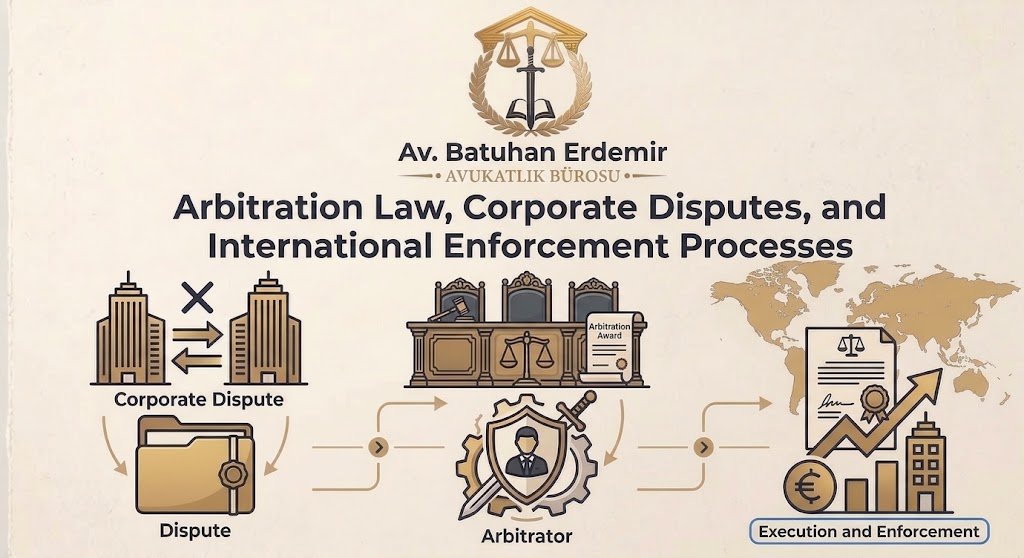
The dizzying speed of modern trade, the immense complexity of multibillion-dollar projects, and the critical need to protect trade secrets often cause traditional state judiciaries to fall short of keeping pace with commercial dynamics due to their classic reflexes. Faced with the heavy caseload of courts and litigation periods lasting for years, arbitration law and enforcement processes stand as the ultimate “Alternative Dispute Resolution” (ADR) mechanism. This route enables parties to resolve their disputes confidentially, impartially, and swiftly through expert arbitrators of their own choosing.
In the rational flow of commercial life, resolving disputes before an arbitral tribunal composed of engineers, economists, and expert jurists who directly grasp the essence of the conflict—rather than letting them languish in state corridors for years—is not a luxury for major corporations, but an operational necessity.
Protection of Trade Secrets and the “Confidentiality” Advantage
The principle of “publicity” (openness) applicable in proceedings conducted in state courts harbors the risk that a company’s financial tables, production costs, or technical know-how, which directly affect its competitive power, might be exposed to rivals. The greatest advantage of arbitration proceedings is that they are based on the principle of absolute “confidentiality.” The dispute process, submitted commercial documents, and the final award remain behind closed doors, thereby securing the companies’ commercial reputation and market power.
Institutional Arbitration Centers and the Risk of “Pathological Clauses”
Arbitration proceedings are divided into two categories: ad-hoc (independent) arbitrations, where the parties freely determine their own procedural rules, and institutional arbitrations, conducted under the administration of established arbitration centers such as ISTAC, ICC, LCIA, or ICSID, subject to institutional rules.
Pursuant to the Civil Procedure Code No. 6100 (HMK), which regulates domestic arbitration in Turkey, and the International Arbitration Law No. 4686 (MTK), which governs disputes with foreign elements, arbitration relies on the written mutual intent of the parties. If the arbitration clause added to the contract is incomplete, contradictory, or ambiguous (known in the literature as a “pathological arbitration clause”), the entire system can lock up when a dispute arises, condemning the parties to lengthy court proceedings once again.
Technical details such as whether the number of arbitrators will be single or odd, where the “seat of arbitration” will be located, and what the substantive law will be are the most critical legal architectural elements during the contracting phase that determine the resolution course of a potential future commercial conflict.
Annulment of Arbitral Awards and Limited Judicial Review
Arbitral awards rendered as a result of arbitration proceedings are not subject to a traditional appeal or appellate review (review on the merits). However, an “Annulment Action” (Setting Aside) can be filed against arbitral awards before the Commercial Courts of First Instance only on the limited grounds enumerated under Article 439 of the HMK (or Article 15 of the MTK).
In an annulment action, the court does not delve into the merits of the dispute or discuss the correctness of the decision; it merely conducts a narrow review within a procedural framework, such as party capacity, the selection of arbitrators, violation of the right to be heard, or whether the award is contrary to “public policy.”
The New York Convention and Enforcement of Foreign Arbitral Awards
The heart of the arbitration law and enforcement mechanism is the enforceability of the arbitral award once it becomes final and binding. Should the debtor party refrain from paying, international recognition and enforcement processes must be swiftly executed.
Thanks to the provisions of the 1958 New York Convention and the Law on Private International Law and International Civil Procedure No. 5718 (MÖHUK), an arbitral award rendered in one country (e.g., LCIA in London) can be enforced in Turkey—or in more than 170 countries worldwide—as if it were a local court decision, allowing for the attachment of the debtor company’s global assets.
Strategic Dispute Resolution and Party Representation (Counsel)
The strategic process conducted for the effective establishment of justice in corporate disputes encompasses the following stages:
- Establishing the contract infrastructure in international commercial agreements by drafting flawless and unified “Arbitration Clauses” to prevent potential judicial deadlocks.
- Executing the most effective party representation (counsel) before the arbitral tribunal in ISTAC, ICC, or ad-hoc proceedings with strong evidence, legal opinions, and technical expert reports.
- Swiftly concluding enforcement lawsuits within the framework of the New York Convention for the purpose of attaching assets in Turkey for arbitral awards rendered in foreign countries (or attaching assets abroad for Turkish awards).
Defense in commercial disputes is the art of ensuring that a fair justice mechanism, established by the will of the parties, comes to life in global trade without stumbling over national bureaucratic hurdles. To manage your holding’s arbitration processes, revise arbitration clauses, and initiate enforcement lawsuits, you can contact us through the contact section of our website.
Legal Notice and Disclaimer
All articles, analyses, and legal evaluations contained on this website are provided for general informational purposes only and do not, under any circumstances, constitute a formal legal opinion, legal advice, or consultancy intended to be applied to a specific dispute or legal situation.
Due to the dynamic nature of legislation and the unique material characteristics of each concrete case, our firm accepts no liability for any loss of rights that may arise from actions taken or decisions made in reliance upon these texts.
You may contact us directly to have your legal problems resolved, to obtain a professional legal opinion based on your specific case file, or to schedule an appointment for verbal consultancy services.