
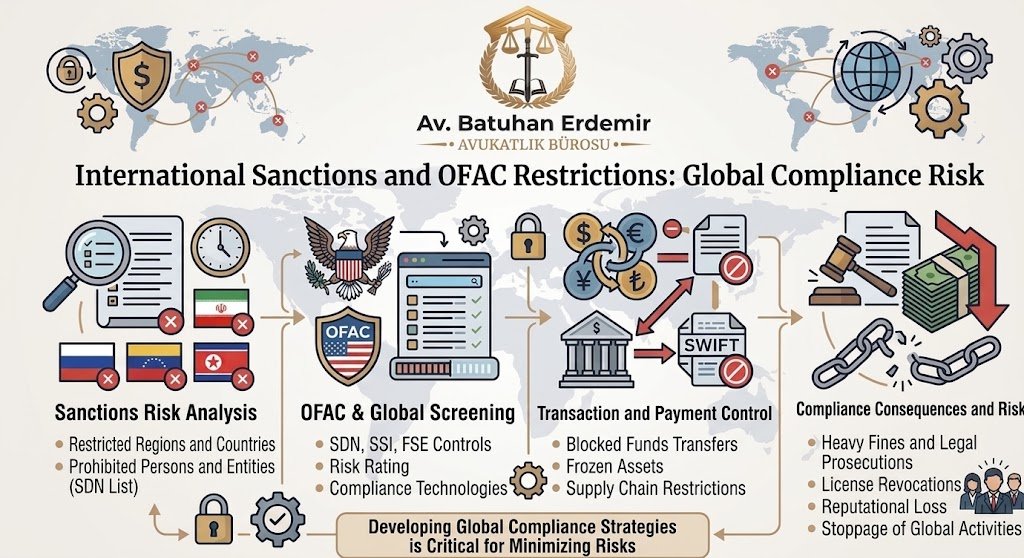
The digitalization of the global economy and the execution of financial transactions through dominant currencies such as the US Dollar (USD) or the Euro (EUR) have carried the economic restrictions of national states or international organizations (United Nations, EU, US Department of the Treasury – OFAC) far beyond geographical borders. In this context, international sanctions and OFAC restrictions, which companies fear most, represent the most ruthless and unpredictable niche area of international politics and trade, where legal mechanisms operate most severely.
Due to the principle of “extraterritoriality” (cross-border effect), even a Turkish company operating in Turkey—without being a US or EU citizen—can become the target of sanction lists overnight simply for utilizing the international financial system (SWIFT) or trading goods containing US-origin components. Companies whose legal and commercial infrastructure is vulnerable to these risks face not only massive fines but the imminent danger of being entirely wiped out from the global market.
Secondary Sanctions and the Red Lines of Global Trade
The most dangerous dimension of the sanctions regime enforced by the US Department of the Treasury’s Office of Foreign Assets Control (OFAC) is the “Secondary Sanctions” mechanism. If a Turkish company engages in a “significant” commercial transaction with a country sanctioned by the US (e.g., Iran or Russia) or a sanctioned entity, it will fall onto OFAC’s radar, even if that company has absolutely no ties to the United States.
Upon the triggering of secondary sanctions, intermediary institutions, logistics companies, and even correspondent banks that breach or facilitate the breach of sanctions are directly penalized. This reality necessitates the reinterpretation of “Force Majeure” clauses in commercial contracts and the mandatory inclusion of strict “Sanctions Compliance” clauses.
Asset Freezing, the SDN List, and “False Positive” Crises
The most devastating consequence of sanctions regimes is the freezing of assets of suspicious or targeted individuals and institutions, completely isolating them from the global financial system like a “commercial leper” (e.g., the US SDN – Specially Designated Nationals List). The international banking transactions of a company included in these lists are instantly locked, commercial partners immediately terminate their collaborations, and the company becomes operationally paralyzed.
Often, innocent companies are mistakenly caught in these lists due to name similarities, complex holding and partnership structures (the 50 Percent Rule), or indirect/past commercial relationships. These “False Positive” cases turn commercial life upside down. At this point, it is of vital importance to eliminate administrative errors and unjust listings through rational and aggressive legal arguments.
Domestic Law Reflections in Turkey: MASAK and Asset Freezing
International sanctions adopted through United Nations Security Council (UNSC) resolutions are also directly and swiftly integrated into domestic law in Turkey. Under the Law No. 6415 on the Prevention of the Financing of Terrorism and the Law No. 7262 on the Prevention of the Financing of the Proliferation of Weapons of Mass Destruction, the assets of individuals and institutions can be frozen in Turkey by a Presidential decree. Against these processes conducted by the Financial Crimes Investigation Board (MASAK), a swift and strategic legal objection route must be followed in the administrative judiciary (Council of State) with a request for the annulment of the administrative act.
Sanctions Compliance Programs and Aggressive Legal Defense
Success on the axis of international sanctions and OFAC rules is possible not merely by filing a lawsuit after a crisis erupts, but by establishing a flawless compliance architecture before the crisis is born. The strategic process carried out encompasses the following stages:
- Risk Mapping and Know Your Customer (KYC): Instant screening of companies’ supply chains, shareholding structures, and end-user profiles against international sanctions databases, and conducting legal Due Diligence.
- Delisting Processes: Conducting administrative applications, lobbying activities, and evidence-gathering processes before OFAC or EU authorities in accordance with US and European legal standards for clients unjustly or mistakenly included in sanction lists.
- Annulment Actions in National Judiciary: Filing urgent annulment actions before the Council of State (Danıştay) against asset freezing or restriction decisions taken at the national level (by Presidential decree), within the framework of the Constitution and human rights (right to property) principles.
Defense in sanctions law is the art of securing the existence of global commercial actors caught in the middle of geopolitical storms through the universal guarantees of law. To secure your global commercial operations against sanctions risks and to initiate “delisting” processes, you can contact our expert team through the contact section of our website.
Legal Notice and Disclaimer
All articles, analyses, and legal evaluations contained on this website are provided for general informational purposes only and do not, under any circumstances, constitute a formal legal opinion, legal advice, or consultancy intended to be applied to a specific dispute or legal situation.
Due to the dynamic nature of legislation and the unique material characteristics of each concrete case, our firm accepts no liability for any loss of rights that may arise from actions taken or decisions made in reliance upon these texts.
You may contact us directly to have your legal problems resolved, to obtain a professional legal opinion based on your specific case file, or to schedule an appointment for verbal consultancy services.