
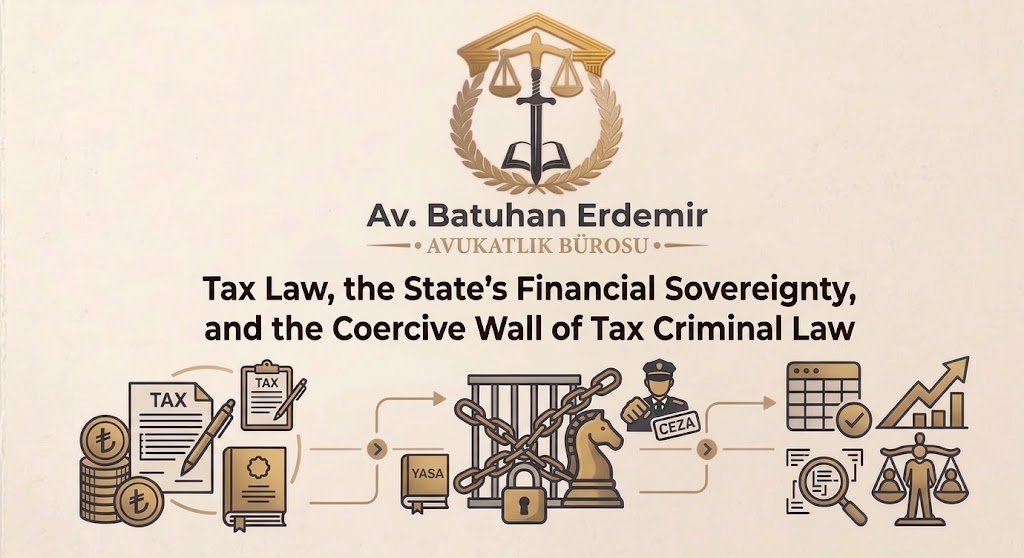
Tax law and tax penalties represent the legal discipline where the tension between the state’s absolute “power of taxation”—utilized to finance public expenditures—and the constitutionally guaranteed property rights of individuals and corporations is experienced most severely and ruthlessly.
Although the “Principle of Legality in Taxation,” enshrined in Article 73 of the Constitution, theoretically appears to protect the taxpayer against the arbitrariness of the administration, in practice, the unilateral actions of the Revenue Administration, imposed tax base increases, sudden tax audits, and colossal fines can turn even well-established commercial enterprises into financial ruins overnight. Faced with the limitless financial power of the state, company boards, squeezed between commercial books and documents and trying to navigate a labyrinth of complex communiqués and circulars, find themselves in the midst of an asymmetric tax war.
Tax Audits, Assessments, and the “Tax Crimes” Dead End
The tax audit process, which begins the moment tax inspectors or auditors knock on the door (or an official notification arrives), is the most tense and error-prone phase of commercial life. Investigations initiated by the administration on suspicions of “collusive transactions,” “disguised profit distribution via transfer pricing,” or “issuing forged/misleading documents” (fake invoices) often cease to be routine audits.
This process evolves into a multi-front attack where the principal tax is demanded through ex officio (re’sen) or additional assessments, tax loss penalties up to three times this amount are imposed, and smuggling/tax evasion charges demanding direct imprisonment under Article 359 of the Tax Procedure Law No. 213 (VUK) are simultaneously triggered. In annulment actions filed in tax courts, refuting the administration’s abstract findings, incomplete examinations, and assumption-based tax difference calculations with independent, concrete data is the only way to save the taxpayer’s liberty and the company’s commercial existence.
A Threat Paralyzing Commercial Life: E-Lien and Precautionary Attachment
Within the axis of tax law and tax penalties, the greatest operational crisis companies face is the attachment (lien) procedures applied for finalized or even unfinalized public receivables. The Law No. 6183 on the Procedure for the Collection of Public Receivables grants the administration the authority to act extremely aggressively and swiftly to collect its dues.
Electronic attachments (E-Haciz) applied by the tax office to all of the company’s bank accounts, title deed registries, and vehicles within seconds, or “Precautionary Attachment” (İhtiyati Haciz) and “Precautionary Accrual” decisions that cause irreparable damages, instantly halt the company’s cash flow. Against these disproportionate coercive collection procedures that make it impossible to pay salaries, clear checks, or pay suppliers, lawsuits requesting an immediate “Stay of Execution” must be filed on the grounds of illegality.
Reconciliation Commissions and Rational Defense Practice in Tax Courts
The establishment of justice in tax disputes requires blending administrative stages and judicial review with a flawless strategy. The fundamental steps of the defense practice carried out to protect the financial and legal survival of companies are as follows:
- Pre- and Post-Assessment Reconciliation: Before resorting to litigation, negotiating against the administration’s unjust penalty and tax demands at reconciliation commissions using strong legal arguments and forensic accounting data, thereby resolving disputes amicably and at a lower cost.
- Annulment Actions and Stay of Execution: Filing urgent “Annulment Actions” in Tax Courts under the Administrative Procedure Law No. 2577 (IYUK) against unjustly imposed tax penalties, notices, and payment orders. In cases where filing a lawsuit does not automatically halt collection (e.g., objections to payment orders), obtaining “Stay of Execution” decisions is vital to prevent commercial paralysis.
- Defense in Heavy Penal Courts (VUK 359): In unjust criminal cases (smuggling/evasion trials) opened with allegations of using or issuing forged invoices, securing acquittal decisions for company executives by proving the absence of the moral element (criminal intent) through commercial book reviews, customs declarations, weighbridge slips, and bank receipts.
Defense in tax law and tax penalties is the art of ensuring that capital, crushed under the unjust, disproportionate, and arbitrary pressure of the state’s financial sovereignty, breathes again through the universal scales of law. To construct a strategic defense against severe tax audits, e-lien actions, and tax criminal cases your company faces, you can contact our expert team through the contact section of our website.
Legal Notice and Disclaimer
All articles, analyses, and legal evaluations contained on this website are provided for general informational purposes only and do not, under any circumstances, constitute a formal legal opinion, legal advice, or consultancy intended to be applied to a specific dispute or legal situation.
Due to the dynamic nature of legislation and the unique material characteristics of each concrete case, our firm accepts no liability for any loss of rights that may arise from actions taken or decisions made in reliance upon these texts.
You may contact us directly to have your legal problems resolved, to obtain a professional legal opinion based on your specific case file, or to schedule an appointment for verbal consultancy services.
TAX CRIMINAL LAW AND HEAVILY SANCTIONED TAX DISPUTES
The State’s Taxation Power and the Taxpayer’s Legal Security
Tax law is a field where the state applies its sovereign power directly and most sharply, and where it can directly interfere with the economic existence of individuals and companies. That the state’s taxation power is not unlimited is secured by the Constitution’s principles of the “legality of tax” and “taxation according to financial capacity.” However, disproportionate assessments established by the administration during tax audit processes, astronomical tax loss penalties, and preliminary attachment practices can drag taxpayers into commercial crises that are difficult to remedy and cause irreparable losses of reputation.
Allegations of Fake Documents (TPL Art. 359) and the Determination of the Element of Intent
The heaviest dimension of tax disputes consists of “Tax Evasion” crimes, which harbor the threat of direct imprisonment rather than merely being an administrative monetary fine. Particularly, allegations of “issuing or using fake or misleading documents in content (fake invoices)” cause even simple omissions within the ordinary course of commercial life to turn into heavy criminal trials. At this point, the most vital legal distinction is the element of “intent” in the act. Creating a chain of liability by ignoring the reality that the taxpayer does not have an absolute obligation—such as auditing the financial history of sub-companies with which they establish commercial relations—is unlawful.
Holistic Defense Practice Against the Threat of Double Sanctions
In tax criminal law, an individual is forced to face simultaneously—due to the same act—both heavy administrative monetary fines in Tax Courts and custodial sentences in Criminal Courts of First Instance (with the risk of violating Ne Bis In Idem, the principle of not being punished twice for the same act). In these complex disputes, the legal process is conducted on a multi-dimensional and rational basis relying on:
- Refuting technical and procedural errors in tax audit reports (TAR) in coordination with financial consultancy and forensic accounting disciplines;
- Subjecting the principle of “concrete evidence,” which serves as the basis for the penalties imposed by the administration, to strict judicial review through annulment lawsuits in the administrative judiciary;
- Demonstrating within the framework of commercial customs that the material and mental elements of the act did not materialize in criminal proceedings.
Legal Notice And Disclaimer
All articles, analyses, and legal evaluations contained on this website are provided for general informational purposes only and do not, under any circumstances, constitute a formal legal opinion, legal advice, or consultancy intended to be applied to a specific dispute or legal situation.
Due to the dynamic nature of legislation and the unique material characteristics of each concrete case, our firm accepts no liability for any loss of rights that may arise from actions taken or decisions made in reliance upon these texts.
You may contact us directly to have your legal problems resolved, to obtain a professional legal opinion based on your specific case file, or to schedule an appointment for verbal consultancy services.