
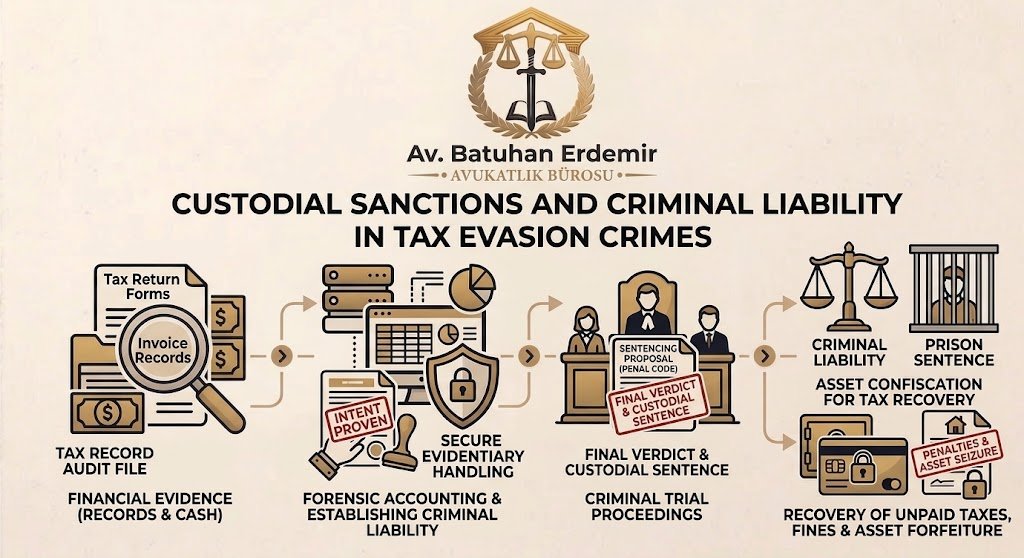
Tax audits conducted within the scope of ordinary commercial activities of companies are generally financial processes resulting in administrative fines or tax assessments. However, certain findings detected during these audits can suddenly transform the dispute from a purely administrative and financial matter into a severe criminal trial that directly threatens the personal liberty of company executives. Regulated under Article 359 of the Tax Procedure Law No. 213 (VUK), tax evasion crimes are among the most serious trials heard in Criminal Courts of First Instance, stipulating direct custodial sentences (imprisonment) completely independent of administrative “tax loss” penalties. Especially in allegations of issuing or using forged or misleading documents, a routine tax inspector audit rapidly evolves into a heavy criminal investigation.
The Evolution of Tax Audits into Criminal Investigations and Legal Risk
In audits conducted by tax inspectors, if it is concluded that the invoices forming the basis of the company’s purchase of goods or services do not reflect a real commercial activity, a Tax Crime Report is issued, and a criminal complaint is filed with the Chief Public Prosecutor’s Office. At this stage, indictments prepared based solely on technical tax reports—often ignoring the commercial realities of the taxpayer—must be subjected to strict legal scrutiny within the framework of the fundamental principles of criminal law.
Accusations of issuing forged invoices (carrying a prison sentence of 3 to 8 years) or using forged invoices (3 to 8 years), due to their lower limits, harbor sanctions far above the limits for postponement or conversion into judicial fines. Consequently, they carry extremely devastating risks for company boards of directors and general managers (C-Level executives).
Criminal Liability of Legal Representatives and the Causal Link
The biggest legal handicap encountered in corporate legal entities is that “financial liability” in administrative law and “personal liability” in criminal law are frequently confused by judicial authorities. Although the legal entity has a corporate financial liability in tax law, the principle of “personal criminal liability” is absolutely essential in criminal trials.
Being a legal representative, board member, or authorized signatory in a company does not directly and automatically generate criminal liability for tax evasion crimes allegedly committed within that company. For a criminal conviction to be established:
- The relevant executive must have a concrete “intent” (mens rea – the will to know and desire) directed towards the unlawful act.
- An absolute “causal link” (causality) between the suspicious act and the executive must be proven beyond any reasonable doubt.
Meticulously analyzing internal delegation of authority agreements, interdepartmental task distributions (e.g., the strict separation of purchasing and accounting departments), and actual signature processes to save board members who lack “criminal intent” from the defendant’s seat is the backbone of the defense strategy.
Proving Commercial Reality in Forged Document Allegations
In practice, your company may be accused as a “user of forged invoices” for reasons entirely beyond your control, such as the sub-company issuing the invoice failing to fulfill its tax obligations, lacking sufficient production capacity, or not being found at its registered address. At this point, the concrete realities of commercial life must be brought to the field against the abstract assumptions of the prosecution.
It must be proven through independent reports that the commercial dispute is not merely about a piece of paper; the reality of the actual commercial relationship must be established through the company’s production capacity, goods purchase-sale flows, supply chain dynamics, and payment channels (bank receipts, checks, waybills, customs declarations, weighbridge slips). In cases where the goods actually entered the enterprise and the price was paid through the official banking system, it is legally indisputable that the material elements of the crime have not materialized.
A Strategic Legal Exit: The Effective Remorse Mechanism
With recent legal amendments in tax criminal law, the institution of “Effective Remorse” (Active Repentance) has been introduced for crimes under VUK Article 359. For executives who wish to eliminate the risk of imprisonment while the trial process is ongoing, this mechanism is a critical strategic move.
According to the law, if the assessed tax, default interest, and half of the imposed administrative penalties are paid during the “investigation phase,” the prison sentence to be given is reduced by half (1/2); if paid during the “prosecution (trial) phase” before the verdict is rendered, a reduction of one-third (1/3) is applied. Making this strategic decision requires a multifaceted cost-benefit analysis, weighing the probability of the case ending in acquittal against the financial and legal risks of a prison sentence.
Holistic Defense and Forensic Accounting in Criminal Files
The defense strategy in tax evasion crimes cases, which harbor the risk of direct imprisonment and commercial disqualification, requires a specific heavy criminal law practice entirely different from tax court processes in administrative jurisdiction. During the trial phase:
- Refuting assumption-based findings and methodological errors in Tax Crime Reports issued by tax inspectors,
- Supporting the reality of the commercial relationship with independent expert opinions and forensic accounting,
- Conducting a meticulous legal analysis of corporate operational matrices to prove that “intent,” the moral element of the crime, did not occur.
In this complex structure where tax disputes and criminal trial processes intertwine, a rational defense practice based on forensic accounting principles and criminal procedure is put forward to prevent company executives from being subjected to unjust restrictions of liberty. To manage the criminal risks you face in your company’s financial processes, you can contact us through the contact section of our website.
Legal Notice and Disclaimer
All articles, analyses, and legal evaluations contained on this website are provided for general informational purposes only and do not, under any circumstances, constitute a formal legal opinion, legal advice, or consultancy intended to be applied to a specific dispute or legal situation.
Due to the dynamic nature of legislation and the unique material characteristics of each concrete case, our firm accepts no liability for any loss of rights that may arise from actions taken or decisions made in reliance upon these texts.
You may contact us directly to have your legal problems resolved, to obtain a professional legal opinion based on your specific case file, or to schedule an appointment for verbal consultancy services.