
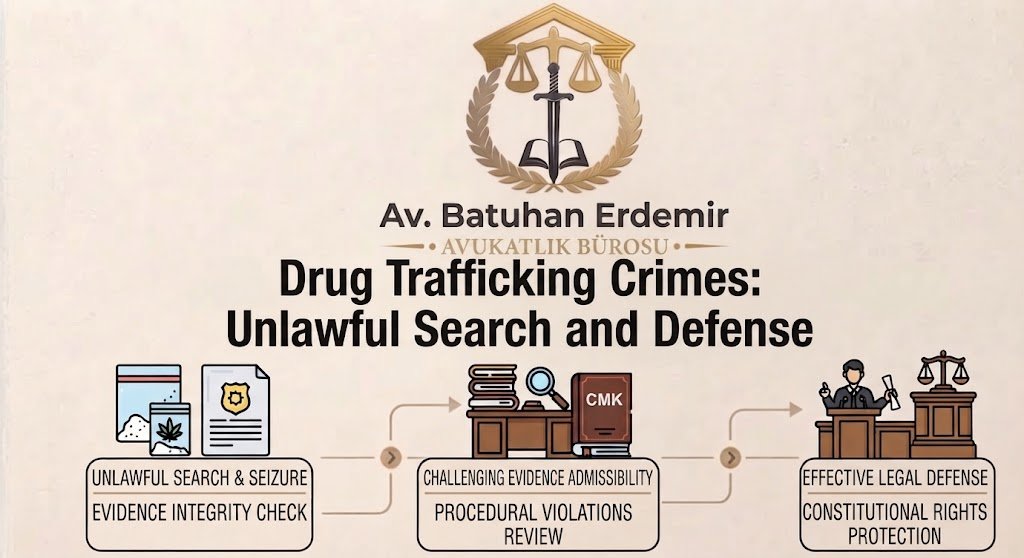
Drug Trafficking Crimes: Unlawful Search and Defense
Narcotic disputes, particularly the violations regulated under Article 188 of the Turkish Penal Code No. 5237 (TCK), stand at the forefront of areas where criminal law is most intertwined with societal sensitivities and where the presumption of innocence is practically most compromised in action. In such heavy penal trials, the severe societal backlash stemming from the nature of the alleged act often paves the way for law enforcement agencies and judicial authorities to make subjective evaluations, pushing the principle of “in dubio pro reo” (the benefit of the doubt goes to the defendant) into the background.
No matter how grave the allegation or the impact of the act on society, the purpose of a trial in a modern state of law is not to create a “criminal” through prejudices and assumptions, but to reach the material truth beyond a reasonable doubt using universal rules of evidence. Public reaction or media pressure cannot serve as a justification for the state to violate the procedural rules it has established. The legal defense to be executed at this juncture is not a moral debate, but rather the art of ensuring that criminal procedure rules (CMK) are operated with mathematical precision.
Drug Trafficking Crimes: Possession for Personal Use vs. Commercial Intent
The most critical and ambiguous legal debate in narcotic files is determining whether the seized illegal substance was possessed “for personal use” (TCK Art. 191) or “for commercial purposes” (TCK Art. 188). Given the disparity in sanctions between the two types of acts (the chasm between a few years of probation and decades of heavy imprisonment), making this fine legal distinction carries vital importance that will shape the client’s entire life.
In most investigations, law enforcement units or the prosecution hastily assume the presence of intent for illegal commerce through “mind-reading,” based solely on the quantity or variety of the seized material, the presence of a precision scale, or the packaging method. However, the established precedents of the Supreme Court of Appeals (Yargıtay) Penal General Assembly are exceptionally clear: Unless it is proven with undeniable, concrete, and convincing evidence—such as physical surveillance, technical wiretapping, or being caught in the act—that the perpetrator acted with the intent to generate profit, it is a legal obligation to evaluate the act within the limits of “possession for personal use.”
Drug Trafficking Crimes: Unlawful Search and the Fruit of the Poisonous Tree
In allegations of drug trafficking crimes, the primary factor determining the ultimate fate of the trial is not the crime itself, but “how” the evidence was obtained by the state’s law enforcement forces. According to the Constitution and Article 116 et seq. of the Turkish Criminal Procedure Code No. 5271 (CMK), any material obtained in vehicles, residences, or body searches without a proper decision from a Criminal Peace Judgeship or a written prosecutor’s order (in cases where delay is prejudicial) constitutes strictly “unlawful evidence” in criminal procedure.
Pursuant to the universal rule expressed in legal doctrine as “The fruit of the poisonous tree is also poisonous,” the quantity, purity, or nature of the illegal material obtained at the end of a process that begins with an unlawful act (e.g., an irregular preventive search or stops made without reasonable suspicion) cannot, on its own, form the basis of a conviction. Removing these unlawful pieces of evidence (the material subject to manufacture or commerce) from the file is the most powerful strategic move that leads to an acquittal.
Agent Provocateur, Undercover Investigators, and Wiretaps
The procedural defense applied against massive files that crush the individual before the state’s entire law enforcement, cyber, and intelligence apparatus in heavy penal trials relies on the following foundations:
- Prohibition of the Agent Provocateur: An “Undercover Investigator” appointed under CMK Article 139 cannot provoke a crime or instigate the perpetrator to commit a crime. According to the decisions of the European Court of Human Rights (ECtHR), if a state agent (police) incites the suspect to engage in illegal commerce (acts as an agent provocateur), the obtained evidence is null and void, and the right to a fair trial has been violated.
- Detection of Communication (Wiretaps): Preventing ordinary daily conversations (commercial jargon or ordinary meeting arrangements) in communication records, which are alleged to be coded, from being interpreted against the defendant before the court based on mere assumptions, without relying on a concrete element of crime or physical delivery (caught in the act).
- Secret Witnesses and Informants: Refuting the statements of hostile informants or anonymous witnesses through a legal filter within the framework of the possibility of slander, especially when they are not supported by any other material evidence (HTS data, camera recordings, bank transactions) in the file.
The duty of the defense counsel here is not to condone the crime, but to protect that fine procedural framework uniformly and fairly for everyone, preventing the criminal justice system from slipping into arbitrariness and assumption. For strategic legal representation regarding objections to search warrants, determining the TCK 191/188 boundary, and expelling unlawful evidence from the file in drug trafficking crimes, you can contact our expert heavy penal team through the contact section of our website.
Legal Notice and Disclaimer
All articles, analyses, and legal evaluations contained on this website are provided for general informational purposes only and do not, under any circumstances, constitute a formal legal opinion, legal advice, or consultancy intended to be applied to a specific dispute or legal situation.
Due to the dynamic nature of legislation and the unique material characteristics of each concrete case, our firm accepts no liability for any loss of rights that may arise from actions taken or decisions made in reliance upon these texts.
You may contact us directly to have your legal problems resolved, to obtain a professional legal opinion based on your specific case file, or to schedule an appointment for verbal consultancy services.