
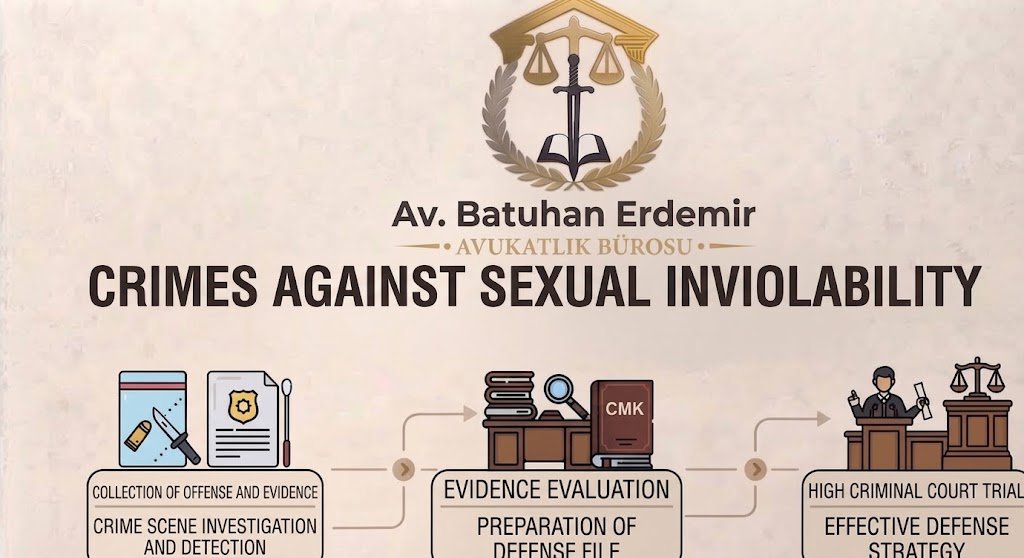
Crimes Against Sexual Inviolability: Defense and Evidence
At the forefront of areas where the criminal justice system collides most violently with societal sensitivities, and where the presumption of innocence is practically most damaged in action, are allegations of severe violations against an individual’s bodily integrity. The reflection of such acts—which inherently and rightfully generate the highest level of outrage in society—in courtrooms often creates a crisis environment where legal rationality is lost, and media pressure and prejudices dominate.
However, in a state of law, regardless of how severe the alleged act is or how much backlash it draws from the public, the trial must be conducted on a cold-blooded and rational ground, completely detached from emotional reflexes on the streets. In these events, which are often claimed to have occurred in secret (behind closed doors), declaring the suspect “guilty” outright in the eyes of the public even when there is no concrete evidence yet directly destroys the right to a fair trial.
The sole duty of the law and strategic defense is not to surrender to the psychology of societal outrage, but to meticulously audit the allegations within the framework of universal procedural rules until the material truth is reached.
The Legal Limits of “The Victim’s Statement is Essential”
The greatest legal dilemma in trials regarding crimes against sexual inviolability, regulated under Article 102 et seq. of the Turkish Penal Code No. 5237 (TCK), is the erroneous (broad) interpretation of the principle “the victim’s statement is essential” by the public and sometimes by law enforcement.
This principle, adopted within the scope of international conventions (e.g., the Istanbul Convention or CEDAW) and national legislation, serves as a “starting point” for taking the complaint seriously, immediately initiating an effective investigation, and promptly applying necessary protective measures (restraining orders, etc.).
However, as repeatedly underlined by the precedents of the Supreme Court of Appeals (Yargıtay) Penal General Assembly and the Constitutional Court, a mere abstract statement alone does not constitute sufficient evidence to sentence a person to decades in prison (to establish a conviction). Regardless of the nature of the allegation or the status of the complainant, the burden of proof always rests entirely on the prosecution.
The Necessity of Concrete Proof and Defamation Analysis
In these highly specific disputes where a truth known only to two people is attempted to be illuminated before judicial authorities months or years later, uncovering the material reality requires multifaceted forensic engineering. Pursuant to the principle of in dubio pro reo (the benefit of the doubt goes to the defendant), the abstract statements in the file must absolutely be supported by rational “corroborating evidence” such as forensic medicine reports, HTS (Base Station and Call) records, camera footage, or statements from impartial eyewitnesses.
The corporate defense mechanism executed in this context relies on the following vital foundations:
- Identifying Contradictions: Auditing the inconsistencies between the parties’ statements, logical errors in the timeline, and the conformity of the event to the ordinary course of life through “Direct Cross-Examination” tactics during the hearing, in accordance with Article 201 of the Turkish Criminal Procedure Code No. 5271(CMK).
- Motive of Hostility and Blackmail: Particularly in the business world, in situations where eliminations between rivals, high-stakes divorce cases, custody crises, or commercial blackmail processes run concurrently, analyzing whether there is an intent of “defamation (slander)” behind the allegations using sociological, financial, and legal data.
- Forensic Sciences (Criminalistics): Re-examining the method by which the incident was reported, psychiatric evaluation reports, and forensic findings with independent expert opinions; thereby refuting indictments constructed upon mere assumptions and mind-reading.
In such stigmatizing files carrying severe sanctions, the duty of the defense counsel is not to mislead justice, but to remove the emotional veil covering the truth through a rational legal practice. For crisis management against allegations concerning crimes against sexual inviolability—which have the potential to end a person’s entire commercial, social, and family life—as well as HTS/Camera data analysis and strategic judicial representation, you can contact our expert heavy penal team through the contact section of our website.
Legal Notice and Disclaimer
All articles, analyses, and legal evaluations contained on this website are provided for general informational purposes only and do not, under any circumstances, constitute a formal legal opinion, legal advice, or consultancy intended to be applied to a specific dispute or legal situation.
Due to the dynamic nature of legislation and the unique material characteristics of each concrete case, our firm accepts no liability for any loss of rights that may arise from actions taken or decisions made in reliance upon these texts.
You may contact us directly to have your legal problems resolved, to obtain a professional legal opinion based on your specific case file, or to schedule an appointment for verbal consultancy services.