
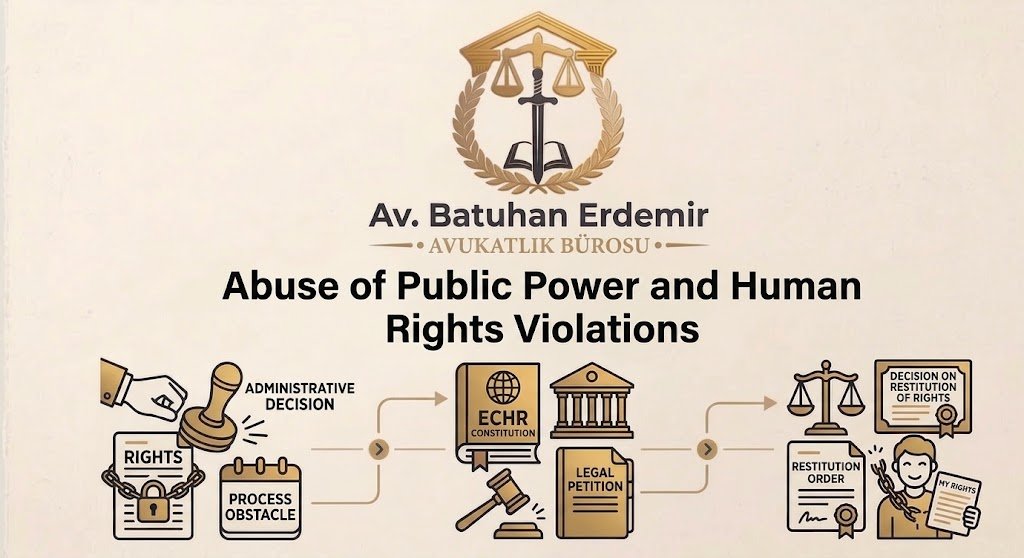
Abuse of Public Power and Human Rights Violations
Abuse of public power and human rights disputes emerge as the most severe legal crises when the state exceeds the boundaries of its legitimate monopoly on the use of force, which is held solely to maintain the constitutional order. While the modern state mechanism is obligated to establish social security, this colossal authority is never an absolute or unlimited tool of domination in any universal legal system.
The intervention limits of law enforcement forces (police, gendarmerie, and correctional officers) are meticulously delineated by universal human rights norms and the Constitution. The disproportionate use of force against individuals during public events or within centers under the state’s direct custody (detention units, holding cells, prisons) constitutes the most violent fault line in the power asymmetry between the individual and the state. A public official stepping outside the bounds of law by hiding behind a uniform and state authority is not merely an attack on the victim’s bodily integrity; it is a direct assault on the legitimacy of the rule of law itself, necessitating a rational and uncompromising judicial struggle.
Abuse of Public Power: The Shield of Impunity
The greatest bureaucratic obstacle encountered in crimes allegedly committed by public officials (such as misconduct in office or exceeding the limits of the authority to use force) is the “permission for investigation” procedure. Under the Law No. 4483 on the Trial of Civil Servants and Other Public Employees, the administration (Governor’s/District Governor’s Office) must grant authorization before a prosecutor can proceed.
In practice, administrative authorities acting with the reflex to protect their own personnel often deny this permission, creating a de facto “shield of impunity” in cases of severe violations. However, the jurisprudence of the Turkish Constitutional Court (AYM) and the European Court of Human Rights (ECHR) is absolutely clear: In allegations of ill-treatment and torture (Article 94 of the Turkish Penal Code No. 5237), the Chief Public Prosecutor’s Offices must immediately and ex officio initiate an investigation, entirely exempt from the permission requirements of civil servant laws. The bureaucratic hierarchy cannot be allowed to overshadow the supremacy of the law.
The Minnesota Protocol and Preserving Evidence
The greatest risk in criminal investigations concerning human rights violations (disproportionate force, physical, and psychological ill-treatment) is the statute of limitations expiring or the tampering with crucial evidence. In such critical files, classical and superficially prepared standard “assault reports” yield no substantive legal outcome.
The first step in executing an aggressive legal defense is transforming the physical or psychological damage inflicted on the victim into permanent, undeniable evidence through independent and detailed forensic medical reports that comply with the “Minnesota Protocol,” a universal medical and legal standard. Simultaneously, seizing and backing up law enforcement bodycams, CCTV, and city surveillance (MOBESE) records immediately via Criminal Peace Judgeships—before the risk of deletion or overwriting arises—is the most strategic move that alters the course of the investigation against the perpetrators.
Administrative Fault and Full Remedy Compensation Lawsuits
The physical and psychological traumas experienced by a victim as a result of a public official’s wrongful act are not only the subject of criminal law but also of administrative law. The disproportionate use of force during the operation of a public service constitutes a clear “Service Fault” (Maladministration) according to administrative law principles.
Even if acquittals or decisions of non-prosecution arise in criminal trials, material and moral damages suffered by the victim are claimed from the state budget through Full Remedy (Compensation) lawsuits filed in Administrative Courts. Securing deterrent and precedent-setting high moral compensation awards, proportionate to the gravity of the incident, serves as an extremely effective legal braking mechanism to prevent future violations by the administration.
Managing Constitutional Court and ECHR Applications
When domestic legal processes against those representing public power hit the roadblocks of acquittals or “Decisions of Non-Prosecution” (KYOK) in local courts, an international legal vision comes into play. When domestic remedies become ineffective, the legal process does not end; on the contrary, it is elevated to an entirely new dimension.
- Constitutional Court (AYM) Individual Application: Within the statutory period following the finalization of local court processes (the exhaustion of ordinary legal remedies), an application is filed to the Constitutional Court requesting the determination that the right to a fair trial, the right to life, or the prohibition of torture and ill-treatment has been violated.
- The ECHR Process: If a lawful and satisfactory outcome cannot be obtained from the Constitutional Court, the file is escalated to the agenda of the European Court of Human Rights (ECHR) in Strasbourg.
The “Violation Judgments” obtained from these supreme judicial authorities not only ensure that the damages suffered by the victim are compensated with high financial awards but also mandate the reopening of closed local court files through “Retrial,” compelling the punishment of the perpetrators.
For strategic legal representation in breaking the shield of impunity in violations arising from the disproportionate use of force, and in managing supreme judicial processes before the AYM and ECHR, you can contact our expert legal team through the contact section of our website.
Legal Notice and Disclaimer
All articles, analyses, and legal evaluations contained on this website are provided for general informational purposes only and do not, under any circumstances, constitute a formal legal opinion, legal advice, or consultancy intended to be applied to a specific dispute or legal situation.
Due to the dynamic nature of legislation and the unique material characteristics of each concrete case, our firm accepts no liability for any loss of rights that may arise from actions taken or decisions made in reliance upon these texts.
You may contact us directly to have your legal problems resolved, to obtain a professional legal opinion based on your specific case file, or to schedule an appointment for verbal consultancy services.