
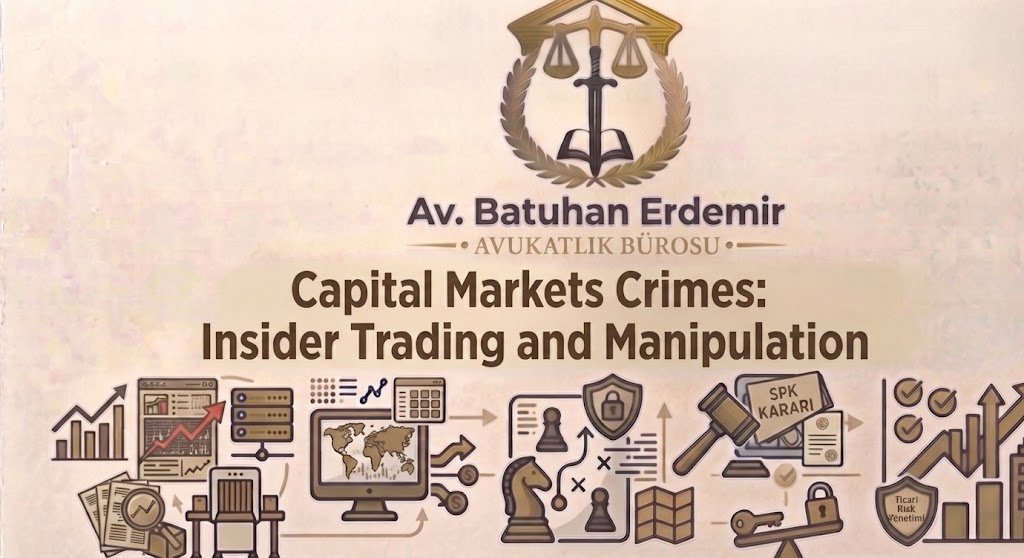
Capital Markets Crimes: Insider Trading and Manipulation
Executives (C-Level), board members, major shareholders of publicly traded joint-stock companies, and the financial professionals advising them are subject to exceptionally strict regulations enforced by official authorities established for market surveillance. However, the misalignment between the dynamically evolving financial ecosystem—measured in milliseconds—and the static rules of law frequently results in perfectly legal commercial moves or algorithmic investment strategies being labeled as “market-distorting actions.”
In this specific domain where administrative sanctions and heavy penal trials intertwine, facing allegations of capital markets crimes directly threatens not only a company’s commercial reputation but also the liberty of its executives and billions of liras of shareholder assets. In these disputes, merely reading legal norms is insufficient; a profound (econometric) analysis of the economic rationality of the executed exchange transactions, market-making rules, and financial time series is strictly required.
Insider Trading Under Financial Regulations
Insider Trading, regulated under Article 106 of the Capital Markets Law No. 6362 (SPKn), involves the use of a corporate secret in exchange transactions to secure an unfair advantage before it is disclosed to the public. As one of the most severe outcomes of Board investigations, the prosecution’s primary basis in this judicial event is often the suspect’s inclusion on the “insider” list.
However, in corporate defense practice, the real issue is proving whether the obtained information was truly “material non-public information” capable of directly affecting the price. Timing discrepancies in Public Disclosure Platform (KAP) notifications, rational investment decisions based on sectoral analysis reports, or pre-set automated trading orders are often erroneously interpreted by official auditors as an asymmetric information advantage. An effective defense involves severing the causal link of intent (mens rea) by proving with financial data that these transactions were coincidental or analytical investment decisions.
Market Manipulation and Algorithmic Fallacies
Market Fraud (Manipulation), regulated under Article 107 of the SPKn, is divided into two categories: transaction-based and information-based. Interpreting ordinary price fluctuations on the order book, High-Frequency Trading (HFT), or panic selling stemming from investor psychology directly as “manipulative intent” is an administrative prejudice.
Particularly in allegations involving “Wash Sales” or “Spoofing” (entering and canceling fake orders), completely rational moves made by an investor or a brokerage firm for the purpose of providing liquidity, hedging against risk, or rebalancing a portfolio can be portrayed as elements of an offense. During the trial phase, it must be presented to the court panel through independent expert opinions obtained from university finance departments that the material elements of the alleged offense did not materialize and that there was no intent to create artificial price or demand.
Dual Judicial Review and Administrative Annulment
Against the bulletin decisions of the Capital Markets Board (SPK) that paralyze the commercial lives of individuals and institutions, block accounts, and impose severe trading bans, administrative and penal crisis management must be conducted in a coordinated manner:
- Administrative Jurisdiction (Annulment Lawsuits): Subjecting the astronomical administrative fines imposed by the Board and the temporary/permanent trading bans (measures) enforced on the exchanges to annulment lawsuits in Administrative Courts on the grounds of disproportionality and lack of legal basis.
- Penal Proceedings (Heavy Penal Court): At the prosecutorial stage and before the court, refuting the unilateral audit reports prepared by SPK experts within the framework of independent auditing standards, Derivatives Market (VIOP) data, and econometric rationality.
- Corporate Governance and Compliance: Ensuring that ambiguities in the KAP notification processes of companies and internal information access procedures are interpreted in favor of the defense within the context of penal law.
The legal vision in the financial ecosystem is to protect the property rights of investors, brokerage firms, and company executives against the aggressive interpretations of bureaucratic regulations. For strategic representation regarding objections to SPK bulletins, lifting trading bans, and defense in capital markets crimes, you can contact our expert heavy penal and commercial law team through the contact section of our website.
Legal Notice and Disclaimer
All articles, analyses, and legal evaluations contained on this website are provided for general informational purposes only and do not, under any circumstances, constitute a formal legal opinion, legal advice, or consultancy intended to be applied to a specific dispute or legal situation.
Due to the dynamic nature of legislation and the unique material characteristics of each concrete case, our firm accepts no liability for any loss of rights that may arise from actions taken or decisions made in reliance upon these texts.
You may contact us directly to have your legal problems resolved, to obtain a professional legal opinion based on your specific case file, or to schedule an appointment for verbal consultancy services.