
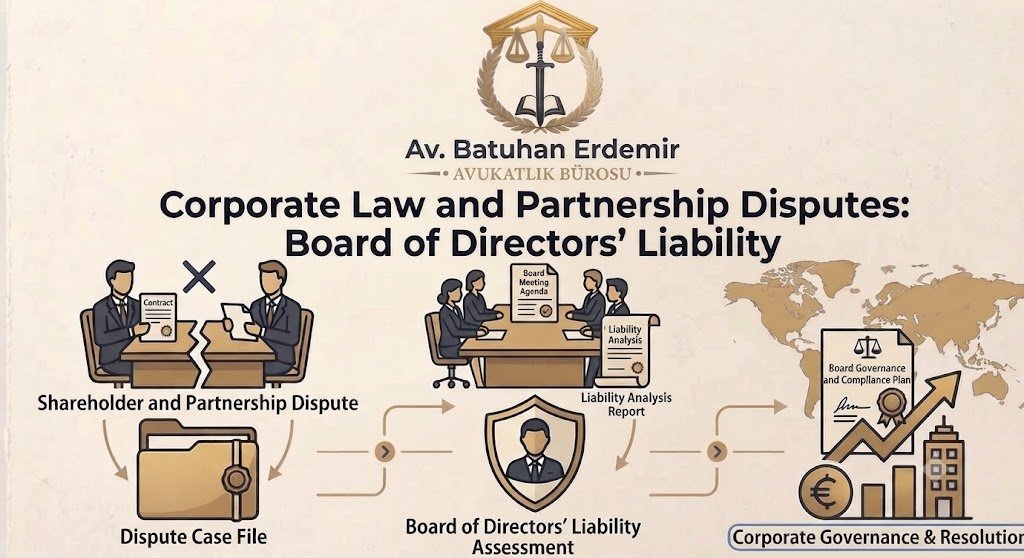
In modern commercial life, joint-stock and limited liability companies, which harbor immense capital, complex organizational structures, and thousands of employees, must combat not only external market conditions but often crises within their own internal dynamics. In this context, corporate law and partnership disputes constitute the most strategic discipline of commercial law, where internal strife, management vulnerabilities, and capital conflicts that directly threaten the company’s existence are resolved with a “legal scalpel.”
The long-term survival of companies depends on maintaining the delicate balance among shareholders and ensuring that boards of directors act in accordance with the law, transparency, and accountability. The corporate legal practice that steps in the moment this balance is disrupted prevents irreversible damage to company balance sheets and commercial reputation.
Board of Directors’ Liability and Fiduciary Duties
The legal and criminal liability of those who manage companies (board members, managing directors, executive officers) is one of the most critical edge areas of commercial law. Pursuant to Article 369 of the Turkish Commercial Code No. 6102 (TCC), managers must perform their duties with the “duty of care” of a prudent executive and safeguard the interests of the company within the framework of the rules of good faith.
If managers violate their “fiduciary duties” (duty of loyalty) to the company, engage in transactions with the company in violation of the non-compete obligation, execute disguised profit transfers, or unjustly enrich themselves, it is possible to compensate the resulting corporate damages from the personal assets of the managers (Liability Lawsuits). Attempts by executives to empty the company from the inside by hiding behind the “corporate veil” are thwarted by strategic lawsuits to be filed in the Commercial Courts of First Instance.
General Assembly Crises and Disputes over Discharge (İbra)
The platforms where internal corporate conflicts become most visible are the Ordinary or Extraordinary General Assembly meetings. The institution of “Discharge from Liability” (İbra), which means the shareholders acquit the board members of their transactions in the past fiscal year, draws the boundaries of legal liability.
However, if there is suspicion of irregularity in management, it is of vital importance to strategically organize decisions “not to discharge” the managers at general assembly meetings or to file lawsuits for the annulment of unlawfully adopted general assembly resolutions. For managers who are not discharged, legal proceedings are immediately initiated to compensate for the damages suffered by the company.
Shareholder Conflicts: Minority Rights and Special Auditors
Especially in family-owned businesses or multi-shareholder structures, it is a common problem for majority shareholders (controlling partners) to abuse their power, suppress minority shareholders (squeeze-out), and deprive them of profits.
The protection of minority rights on the axis of corporate law and partnership disputes is specifically guaranteed by the TCC. In the presence of reasonable suspicion, the appointment of a “Special Auditor” (TCC Art. 438) can be requested from the court to examine the company’s accounting and commercial transactions. Through this mechanism, disguised profit transfers, disclosure of trade secrets, and fictitious transactions are officially evidenced by independent audit and forensic accounting expertise.
Dissolution for Just Cause and Expulsion (Deadlock)
In deadlock situations where animosity between partners makes the commercial activities of the company unsustainable, the legislator has granted the right to file a lawsuit for “Dissolution for Just Cause.” However, considering that the dissolution (liquidation) of the company would be an economic destruction, courts may decide instead to “expel the responsible partner” from the company and pay out their share over its actual value (alternative solutions).
The proactive legal process conducted to establish justice in corporate disputes encompasses aggressive yet rational moves such as:
- Placing precautionary attachments on the personal assets of at-fault managers or partners against the risk of company assets being smuggled,
- Providing mathematical proof of damages through forensic accounting reports,
- Re-establishing the economic balance before arbitral tribunals or Commercial Courts.
To manage the board of directors’ liability, general assembly disputes, or partnership crises you face in your company with professionalism and strict confidentiality, you can contact our corporate team through the contact section of our website.
Legal Notice and Disclaimer
All articles, analyses, and legal evaluations contained on this website are provided for general informational purposes only and do not, under any circumstances, constitute a formal legal opinion, legal advice, or consultancy intended to be applied to a specific dispute or legal situation.
Due to the dynamic nature of legislation and the unique material characteristics of each concrete case, our firm accepts no liability for any loss of rights that may arise from actions taken or decisions made in reliance upon these texts.
You may contact us directly to have your legal problems resolved, to obtain a professional legal opinion based on your specific case file, or to schedule an appointment for verbal consultancy services.
PIERCING THE CORPORATE VEIL AND HOLDING COMPANY LIABILITY
The Abuse of the Principle of Limited Liability in Capital Companies
The most fundamental pillar of modern commercial law is the principle of “limited liability” in joint-stock and limited liability companies. As a rule, partners are responsible for the debts of the company only up to the amount of capital they have committed; their personal assets are under the protection of the law. However, when this legal shield is used maliciously to defraud creditors, execute fraudulent bankruptcy plans, or transfer main assets to other group companies (shell companies), one of the greatest crises of the legal system arises. Accepting the “real bosses”—who hide behind companies intentionally hollowed out to avoid paying workers’ compensation, public tender prices, or supplier debts—as legally untouchable means the bankruptcy of justice.
Piercing the Corporate Veil (Organic Bond Theory) and Tracking Claims
Setting up a new company at the same address, with the same managers, and with the same logo by hollowing out the debtor company (organic bond) is an illusion frequently encountered in commercial life. The heaviest legal weapon shaped by Supreme Court precedents against these fraudulent dispositions is the theory of “Piercing the Corporate Veil.” This theory ensures that in cases where rights are abused, the formal boundaries of the law are bypassed to reach the personal assets of the real managers, shareholders, or the parent company in the background. In situations where capital, personnel, and bank accounts are intertwined and used within a group of companies (holding) (alter ego), the bill for the debt cannot be legally permitted to be handed solely to the bankrupt subsidiary.
In-Depth Action for Annulment of Dispositions Against Fraudulent Transfers
In order to reach concealed capital and secure the rights of creditors, all facilities of commercial and enforcement law must be operated in the harshest manner:
- Investigating the real estate, vehicle, and trademark transfers of the debtor company from recent years using forensic accounting methods, and filing “Actions for Annulment of Dispositions” (Tasarrufun İptali) within the scope of Article 277 of the Enforcement and Bankruptcy Law before Civil Courts of First Instance against simulated (collusive) transfers;
- Proving the organic bond between group companies through SGK records, trade registry gazettes, and commercial book analyses, thereby directing preliminary attachments directly to the main holding company or dominant partners;
- Initiating criminal sanction processes before Heavy Penal Courts on the grounds of “Fraudulent Bankruptcy” or “Qualified Fraud” against managers who fraudulently hollowed out the company. Corporate commercial law is the struggle to uncover the material truth behind paper-based frauds and force capital to submit to the law.
JOINT VENTURE AND CONSORTIUM CONFLICTS AND STRATEGIC DEADLOCKS
The Nature of Strategic Partnerships and Conflict Potential
State tenders, multi-billion-lira infrastructure/energy projects, or cross-border technology investments harbor risks too large for institutions to undertake alone, necessitating the establishment of “Joint Venture” or consortium structures. These structures, where two or more massive corporate entities temporarily combine their capital, technologies, and human resources to achieve a specific objective, are inherently extremely fragile. One partner’s failure to provide committed financing, vulnerabilities in subcontractor management, or divergent visions in the distribution of profits can turn multi-billion-dollar projects overnight into a construction site dump or a massive lawsuit. When “mutual trust,” which is the foundation of the partnership, disappears, the Joint Venture agreement turns into shackles binding the parties to one another.
Management Deadlock Situations and the Paralysis of the Project
The greatest crisis encountered in joint ventures with equal share structures such as fifty-fifty (%50-%50) is the “deadlock” situation arising as a result of the parties failing to reach a consensus on strategic decisions. The company/venture cannot utilize bank loans, cannot pay employee salaries, and as the project delivery date is delayed, it faces astronomical delay penalties imposed by the administration. A partner intentionally slowing down the project or cutting off financial data flow to squeeze out the other partner is one of the most destructive methods of unfair competition in commercial life. At this stage, the intervention of the law requires rational and surgical precision to prevent the project from collapsing entirely.
Liquidation of Consortiums and Legal Exit Strategies
In joint venture disputes valued at hundreds of millions of dollars, the resolution of the dispute can only be ensured through a multi-dimensional contract and company law practice. In this context:
- Strategically operating exit mechanisms in the partnership agreement, such as “Russian Roulette” or “Texas Shootout,” to force a fair separation process;
- In the presence of just causes, obtaining decisions from civil courts of first instance for the “Dissolution of the Partnership for Just Cause” or the expulsion of the faulty partner from the venture to ensure the continuation of the project from a single source;
- Establishing legal shields through negotiations conducted before the administration (Ministries) in public tenders to prevent the company from falling into the status of being banned from tenders (blacklisted) due to the fault of the other partner.
The purpose is to eliminate corporate ambitions ahead of the project and capital through the judicial power of the state.
CORPORATE INTELLECTUAL PROPERTY, THE THEFT OF TRADE SECRETS (KNOW-HOW), AND UNFAIR COMPETITION
The Corporate Value of Intangible Assets and Industrial Espionage
While the power of companies in the traditional economy was measured by their factories and machinery, in today’s global economy, a institution’s primary capital consists of its patents, software codes, customer databases, production formulas, and trade secrets known as “Know-How.” These massive intangible assets are simultaneously the corporate values that can be most easily stolen and transferred. The transfer of a company’s key customer portfolio by a former manager who left the partnership to a competing firm they established themselves, or the unfair copying of a critical production technology (patent) by a rival company through reverse engineering, is not merely a competition violation, but an “industrial assassination” targeting the existence of the company.
The Boundaries of Unfair Competition and the Disclosure of Trade Secrets
Within the scope of the Turkish Commercial Code (TCC Art. 54), “Unfair Competition” prohibits the disruption of market equilibrium through behaviors contrary to the rule of honesty. Unauthorised exploitation of another’s business products, enticing former personnel to acquire company secrets, or defaming competitors with unfounded accusations (slander) are the most severe violations of this law. Particularly, the situation of “disclosure of trade secrets” creates irreversible market losses for companies. Since compensation for damages that will arise after a know-how falls into the hands of a rival firm can take years, it is essential to deploy a legal mechanism that is much faster, more aggressive, and result-oriented than traditional compensation lawsuits here.
Defending Intellectual Property with Preliminary Injunctions and Judicial Raids
In the protection of corporate intellectual property and trade secrets, time itself is the greatest legal enemy. The operational process conducted before Intellectual and Industrial Property Civil Courts comprises:
- Against the danger of evidence being tampered with, organizing judicial raids without prior notice to the rival firm or violator through “Evidence Determination” lawsuits, thereby placing software, molds, or databases under court supervision;
- Issuing urgent “Preliminary Injunction” decisions to prevent products subject to unfair competition from passing through customs, to collect them, or to suspend their digital access;
- Transforming lost profits (or profits obtained by the violator) arising from trademark, patent, and industrial design violations into pecuniary and non-pecuniary compensation lawsuits at the highest rates. Intellectual property law is the protection of creative labor and innovation against free market cunning with all the instruments of the law.
Legal Notice And Disclaimer
All articles, analyses, and legal evaluations contained on this website are provided for general informational purposes only and do not, under any circumstances, constitute a formal legal opinion, legal advice, or consultancy intended to be applied to a specific dispute or legal situation.
Due to the dynamic nature of legislation and the unique material characteristics of each concrete case, our firm accepts no liability for any loss of rights that may arise from actions taken or decisions made in reliance upon these texts.
You may contact us directly to have your legal problems resolved, to obtain a professional legal opinion based on your specific case file, or to schedule an appointment for verbal consultancy services.