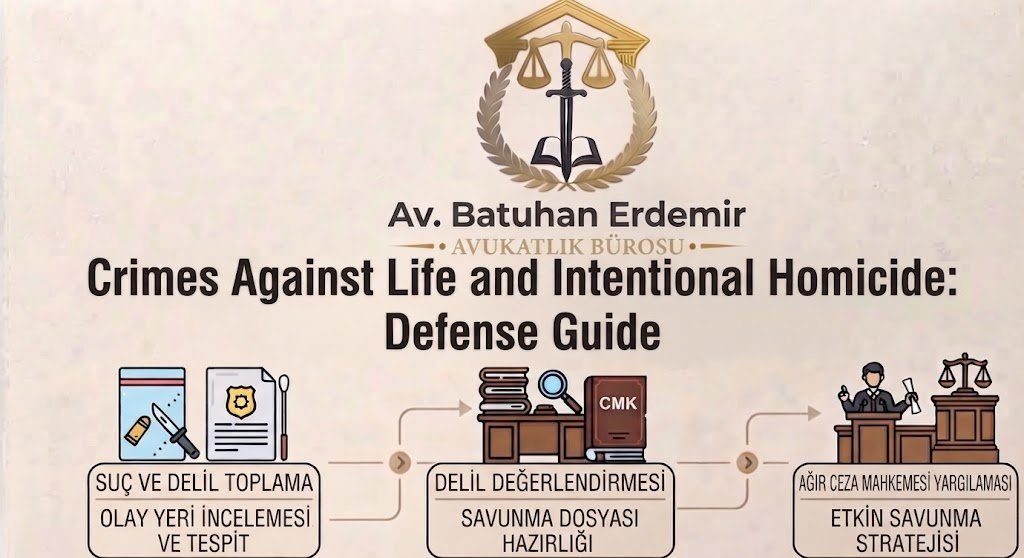
Crimes Against Life and Intentional Homicide: Defense Guide
The most severe area of the criminal justice system, carrying the highest sanctions and the most devastating psychological burden, is the “murder” trials initiated with the allegation of a violation of the right to life. Tragic events resulting in the loss of a human life reflecting in heavy penal courtrooms transcend a mere judicial process; they unfold in the shadow of deep traumas, agony, and often intense societal or media outrage.
In such disputes where the threat of life imprisonment or aggravated life imprisonment is on the table, the risk of the atmosphere in the courtroom diverging from legal rationality and turning into a mechanism of “revenge” is exceedingly high. The duty of the defense counsel in this heavy tableau is not to legitimize the act or engage in a moral debate, but to prevent the state’s power to punish from succumbing to emotional reflexes, ensuring that the cold-blooded, fair, and universal rules of law (such as the presumption of innocence) are operated without compromise.
Crimes Against Life and Intentional Homicide: Intent, Eventual Intent, and Negligence: Legal Qualification
In crimes against life and intentional homicide trials regulated under Article 81 et seq. of the Turkish Penal Code No. 5237 (TCK), the primary element determining whether an individual will remain behind bars for decades is not the act itself, but the “volitional (mens rea)” state directing that act.
Determining whether the resulting death occurred through direct intent (premeditation), through the perpetrator continuing the act despite foreseeing the outcome but disregarding it (eventual intent / dolus eventualis), or as a result of completely unforeseeable carelessness (negligence) requires the most delicate tailoring in criminal law. For instance,if the perpetrator merely intended to injure, but the victim died unexpectedly (Causing Death by Intentional Injury – TCK 87/4), the imposed sentence is reduced by more than half. The perpetrator’s psychological state at the time of the incident, past hostility with the victim, and the development of the event within seconds form the basis of the legal qualification (nature of the crime). A single-word change in the qualification of the crime dictates an individual’s entire future.
Crimes Against Life and Intentional Homicide: Legitimate Defense (Self-Defense) and Unjust Provocation
The most critical defense practices in heavy penal files are conducted over reasons for legal justification and circumstances affecting culpability (TCK Articles 25 and 29). An individual’s use of “proportionate” force to repel an unjust, present, and certain attack directed at themselves or another (Legitimate Defense / Self-Defense) is an absolute reason for acquittal in criminal law, rendering the act non-criminal.
Similarly, the degree of “anger and severe distress” created on the perpetrator’s will by an unjust act (insult, attack,threat) originating from the victim triggers the institution of Unjust Provocation, which creates vital reductions in the sentence to be imposed. These legal institutions are not “excuses” offered to the perpetrator by law; they are the scientific equivalents in criminal law of human nature, fear, instantaneous adrenaline, and the survival instinct. In a concrete case, the simultaneity of the attack and the defense must be examined with microscopic precision.
Establishing the Material Truth Through Forensic Sciences
In “dark” murder files where indictments are based solely on assumptions or contradictory statements by the parties,and where there are no eyewitnesses, a verdict of conviction or acquittal can only be established under the guidance of the Council of Forensic Medicine (ATK) and forensic sciences (criminalistics). The defense in crimes against life and intentional homicide conducted in these multi-variable equations relies on the following strategic foundations:
- Crime Scene and Ballistic Examination: Subjecting crime scene investigation reports, bullet entry-exit holes,bloodstain pattern analyses, and Swap (gunpowder/antimony) residue reports to a scientific cross-examination.
- Autopsy Reports: Determining the extent to which the definitive cause of death (causal link) and the time of death findings in classical autopsy reports align with the defendant’s defense and the physical flow of the event.
- In Dubio Pro Reo (Benefit of the Doubt): In every situation where material evidence fails to form a conviction “beyond a reasonable doubt,” forcefully asserting the universal principle of “the benefit of the doubt goes to the defendant” before the Heavy Penal Courts.
Even the individual facing the heaviest accusation is behind a single legal shield against all the power of the state:”Every accusation that cannot be proven one hundred percent is legally nothing more than a doubt, and doubt is the foundation of acquittal, not conviction.” For strategic legal representation regarding intentional homicide, exceeding the limits of self-defense, and objecting to forensic medicine reports, you can contact our expert heavy penal team through the contact section of our website.
Legal Notice and Disclaimer
All articles, analyses, and legal evaluations contained on this website are provided for general informational purposes only and do not, under any circumstances, constitute a formal legal opinion, legal advice, or consultancy intended to be applied to a specific dispute or legal situation.
Due to the dynamic nature of legislation and the unique material characteristics of each concrete case, our firm accepts no liability for any loss of rights that may arise from actions taken or decisions made in reliance upon these texts.
You may contact us directly to have your legal problems resolved, to obtain a professional legal opinion based on your specific case file, or to schedule an appointment for verbal consultancy services.