
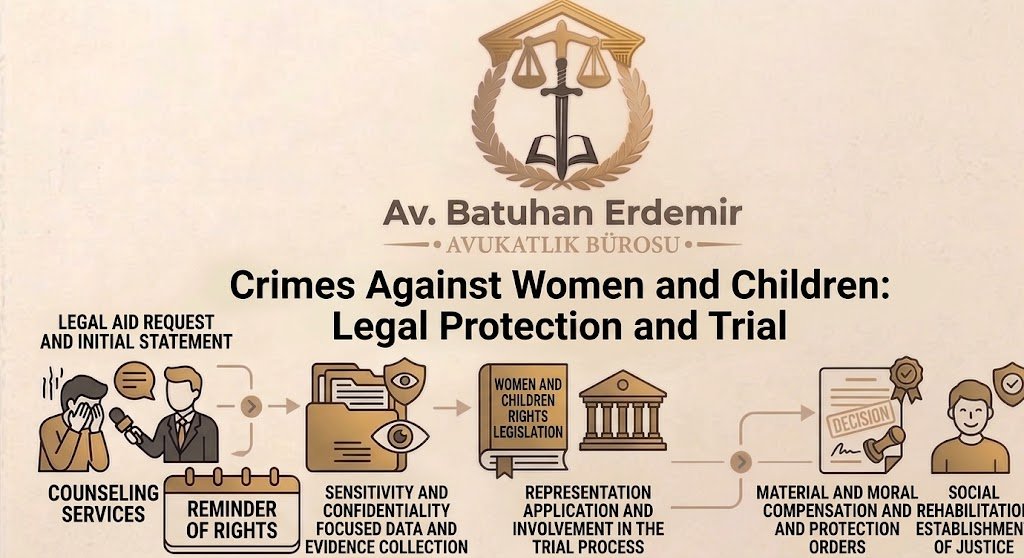
Crimes Against Women and Children: Legal Protection and Trial
Acts of violence, homicide, and sexual abuse, which constitute the most severe violations against the physical and psychological integrity of individuals, are judicial processes that must be conducted with the most sensitive and strict procedural rules of the criminal justice system. Cases of domestic violence or allegations of child abuse are far beyond being merely a legal dispute between two parties; they are the direct projection of the state’s positive obligation to “protect the right to life” in courtrooms.
In such heavy penal files carrying severe sanctions, victims or the relatives of the deceased frequently face the risk of “secondary victimization” due to the strategic defense tactics employed during the trial process, in addition to the trauma created by the perpetrator’s physical act. The sole duty of the attorney representing the intervener (the complainant/victim) here is to ensure that the trial remains on a rational ground, to refute any fictional arguments aimed at legitimizing the perpetrator’s actions using universal rules of evidence, and to defend the rights of the victim without compromise.
Auditing Unjust Provocation and Discretionary Mitigation
The strategy most frequently resorted to by defense attorneys in heavy penal files is to push the boundaries of the “Unjust Provocation” (Article 29) and “Discretionary Mitigation” (Article 62) institutions regulated under the Turkish Penal Code No. 5237 (TCK) in order to reduce the sentence the perpetrator will receive to the minimum limit. Particularly taking advantage of the fact that the victim is no longer alive or cannot confront the perpetrator, unfounded allegations of infidelity, insult, or attack—unsupported by any material evidence—may be introduced into the file.
Furthermore, there is a risk that the perpetrator’s mere formal attitude in the courtroom (e.g., wearing a tie, remaining silent) is unlawfully considered a reason for a “good conduct reduction.” In a rational practice of victim representation, these fictional defenses are neutralized through the following procedural steps: The perpetrator’s intent of “premeditation (planning)” prior to the incident is proven through HTS (base station) records, search engine history, camera logs, and digital data analysis. This presents to the court panel that the act was not the result of a momentary “frenzy or provocation” but was executed with a systematic will, thereby completely blocking the perpetrator’s avenues for unlawful sentence reductions.
Victim-Blaming and the Boundaries of the Trial
The greatest procedural error disrupting the rationality of criminal law in trials regarding crimes against women and children is the attempt to put the victim’s lifestyle, past, clothing, or profession on trial under the guise of a defense tactic. Defined in legal literature as “victim-blaming,” this approach serves no purpose in uncovering the material truth.
The duty of criminal courts is not to make a value judgment based on the moral or sociological profile of the victim, but to establish the absolute illegality of the act committed by the perpetrator. Particularly in TCK Article 102 (Sexual Assault) and TCK Article 103 (Sexual Abuse of Children) files, immediate procedural objections must be raised against questions and psychological manipulations directed at the victim’s sphere of privacy aimed at mitigating the perpetrator’s crime, and shifting the focus of the trial away from the “concrete act” must be strictly prevented.
Protective Measures Under Law No. 6284 and State Liability
Protecting a victim caught in a cycle of violence is an urgent, immediate, and vital crisis management process that cannot be left to the final verdicts of criminal cases that take years. The legal process conducted in this context includes the following steps concurrently with the criminal case:
- Preventive and Protective Measures: Pursuant to Law No. 6284 on the Protection of the Family and Prevention of Violence Against Women, decisions such as removing the perpetrator from the residence, blocking communication, confiscating their weapons, and concealing the victim’s identity/address information are obtained from Family Courts within hours.
- Coercive Imprisonment: In the event that the court’s precautionary decisions are violated by the perpetrator (e.g., approaching or messaging the victim), the violation is documented, and the mechanism of “Coercive Imprisonment” ranging from 3 to 30 days is immediately initiated against the perpetrator.
- State Liability (Service Fault): If state institutions (law enforcement, prosecution) fail to fulfill their obligation to protect despite complaints made to them, and the victim suffers harm as a result, substantial lawsuits for material/moral compensation are filed against the administration in Administrative Courts on the grounds of “service fault.”
The area contested in these disputes is not merely a criminal file; it is the absolute defense of the “right to life and bodily integrity,” the most fundamental human right guaranteed by the Constitution. For professional legal representation regarding the intervener status in the context of crimes against women and children, urgent precautionary decisions under Law No. 6284, and compensation processes, you can contact our expert team through the contact section of our website.
Legal Notice and Disclaimer
All articles, analyses, and legal evaluations contained on this website are provided for general informational purposes only and do not, under any circumstances, constitute a formal legal opinion, legal advice, or consultancy intended to be applied to a specific dispute or legal situation.
Due to the dynamic nature of legislation and the unique material characteristics of each concrete case, our firm accepts no liability for any loss of rights that may arise from actions taken or decisions made in reliance upon these texts.
You may contact us directly to have your legal problems resolved, to obtain a professional legal opinion based on your specific case file, or to schedule an appointment for verbal consultancy services.