
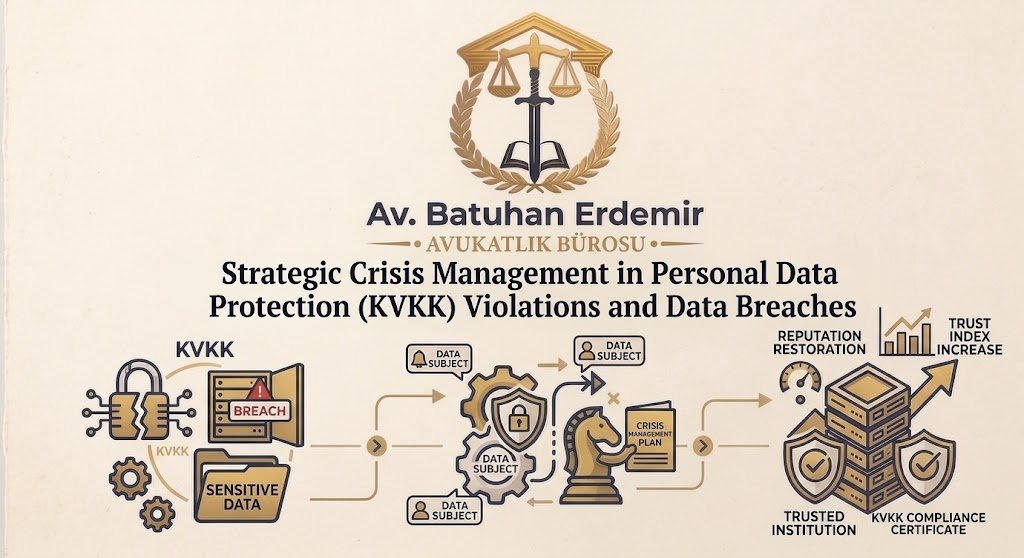
Strategic Crisis Management in KVKK Violations and Data Breaches
With the acceleration of digitalization, data has become the most valuable asset of modern companies. This reality makes ensuring data security and strict compliance with the Personal Data Protection Law No. 6698 (KVKK) one of the highest-level responsibilities of company management and boards of directors.
A potential cyberattack, an internal threat-sourced data leak, or ex officio investigations initiated by the Personal Data Protection Board (the Board) can lead to heavy administrative fines as well as an irreparable loss of commercial reputation. At this point, KVKK violations and data breaches transcend being merely an Information Technology (IT) or legal department issue; they transform into a strategic crisis management process that requires the coordinated, rapid action of all company units.
The First 72 Hours in Data Breaches: A Race Against Time and Transparency
When a data breach is detected, the most critical stage of the process is the first 72 hours. By law, it is a legal obligation for the data controller to notify the Personal Data Protection Board of the situation within 72 hours at the latest from the moment the breach is learned. Within this brief timeframe, the scope of the breach must be determined, which data categories have been leaked must be accurately identified, and the technological source of the leak must be sealed.
The steps taken at this stage directly affect the severity of the fine to be imposed by the Board. During the notification process, conveying to the Board—using proper legal language—how much of the technical and administrative measures the company had proactively taken ensures that the crisis remains manageable. An incomplete, incorrect, non-transparent, or untimely notification can pave the way for sanctions much heavier than the incident itself in the context of KVKK violations and data breaches. Therefore, while evaluating the legal aspect of the incident, it is imperative that cybersecurity teams quickly complete the digital forensics processes and present accurate data to the crisis desk.
Board Investigations and the Defense of Administrative and Technical Measures
The Personal Data Protection Board conducts detailed investigations against companies upon data breach notifications or complaints from data subjects. The Board’s primary point of examination is not merely whether a leak occurred; it is whether the data controller company took all necessary technical (e.g., penetration tests, DLP software, encryption protocols) and administrative (e.g., personnel training, non-disclosure agreements, authorization matrices) measures to ensure the appropriate level of security mandated by the law.
The defense strategy here relies on proving that the company was not negligent and that it implemented security protocols at global standards. Supporting the defense with independent technical expert reports—demonstrating that the breach occurred as a result of an unforeseeable and sophisticated (zero-day) cyberattack that developed despite reasonable precautions—constitutes the backbone of the case. Since defenses written purely in legal language will fall short in explaining the adequacy of the technical infrastructure to the Board’s experts, it is mandatory for data protection lawyers and cybersecurity experts to construct a joint defense text.
Objections to Administrative Fines and Personal Compensation Lawsuits
The imposition of administrative fines amounting to millions of liras against the company by the Board, on the grounds of violating data security obligations, is not the end of the legal process. Objecting to these administrative sanction decisions before the Criminal Judgeships of Peace within the legal period following the notification of the decision is a critical step for the cancellation or reduction of the fine. In the objection petition, the legal groundlessness, disproportionality, or incomplete examinations in the Board’s decision must be rigorously refuted in light of the jurisprudence of the Court of Cassation and the Constitutional Court.
On the other hand, another major danger companies face following KVKK violations and data breaches is the material and moral compensation lawsuits to be filed by customers or employees whose data was compromised. In these lawsuits, proving that the “causal link” (causality) between the leak and the damage suffered by the victim is broken, and demonstrating the company’s lack of fault, is essential to eliminate a potentially massive compensation burden.
Reputation Management and the Balance of Stakeholder Communication
Data breaches cause a massive breach of trust in the eyes of consumers, investors, and business partners. The Board’s transparent sharing of breach notifications with the public on its official website causes the incident to be rapidly reported by the mainstream media. This situation confronts the company not only with legal authorities but also with the public and anxious customers.
Remaining silent or attempting to cover up the incident during a crisis is the biggest mistake, one that accelerates the loss of reputation and dramatically lowers share values. Instead, a transparent and reassuring corporate communication language should be adopted, indicating that the incident is under control and that necessary steps have been taken to protect affected users. The content of the individual notifications to be made to the affected persons must be calm enough not to cause panic, yet clear enough to explain their legal rights and the risks involved.
The Importance of Holistic Coordination and Expert Counsel
Consequently, data breaches and Board investigations are multifaceted crisis processes with legal, technical, and communicative dimensions. Successful management is possible through the convergence of cybersecurity experts, data protection (IT) lawyers, and corporate communication units at a joint crisis desk under the leadership of company management.
Approaching the dispute not merely as a risk of paying a fine, but as a test of preserving the company’s presence and reliability in the digital ecosystem, will provide the most enduring and sound solution. To receive professional support regarding the auditing of your company’s KVKK/GDPR compliance processes, the management of data breach crises, and pursuing legal remedies against administrative fines, you can contact our expert team through the contact section of our website.
Legal Notice and Disclaimer
All articles, analyses, and legal evaluations contained on this website are provided for general informational purposes only and do not, under any circumstances, constitute a formal legal opinion, legal advice, or consultancy intended to be applied to a specific dispute or legal situation.
Due to the dynamic nature of legislation and the unique material characteristics of each concrete case, our firm accepts no liability for any loss of rights that may arise from actions taken or decisions made in reliance upon these texts.
You may contact us directly to have your legal problems resolved, to obtain a professional legal opinion based on your specific case file, or to schedule an appointment for verbal consultancy services.