
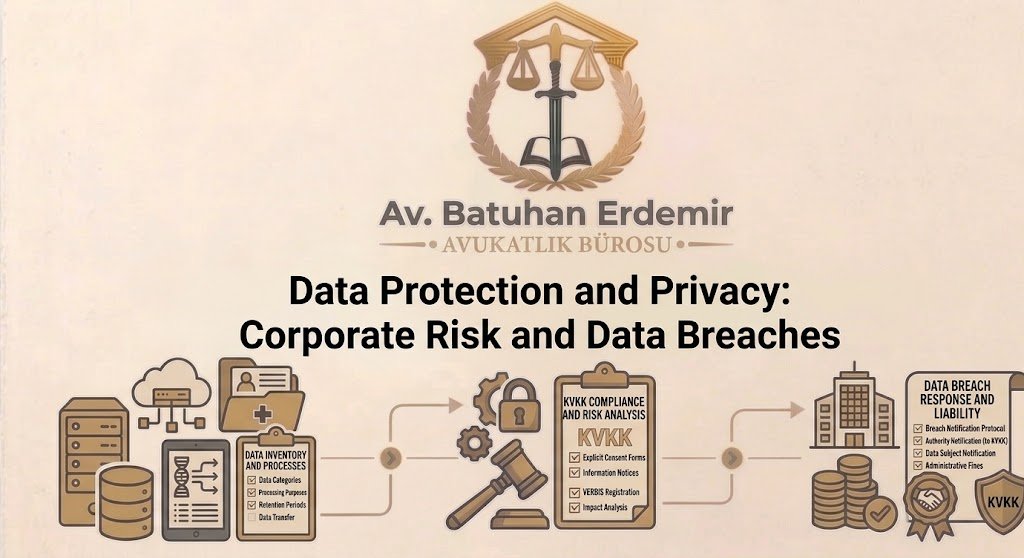
Data Protection Law and Privacy: Corporate Risk and Data Breaches
In the current digital information age, “data” has surpassed crude oil to become the most valuable financial asset of global corporations, serving as the fundamental dynamo for digital marketing, predictive algorithms, and artificial intelligence. As the processing of the most intimate details—such as individuals’ health data, financial histories, location information, and consumer habits—translates into massive economic value, establishing a delicate legal equilibrium between companies (data controllers) and the individuals whose data is processed has become an absolute necessity.
At this precise juncture, data protection law and GDPR compliance—alongside its Turkish equivalent, the Law No. 6698 on the Protection of Personal Data (KVKK)—is not merely a bureaucratic procedure confined to paper. It is the most critical “corporate risk management” and reputational discipline of the data-driven modern economy. Processing or disclosing an individual’s digital footprints without explicit consent, thereby breaching the boundaries of constitutionally guaranteed “information privacy,” exposes multinational companies to irreversible financial devastation and regulatory blockades.
Data Protection Law and GDPR Compliance: Corporate Non-Compliance
The greatest strategic error encountered in commercial life is companies viewing compliance processes merely as a formal obligation, reduced to copy-pasted “privacy notices” or mechanical consent checkboxes on their websites. E-commerce platforms profiling customers through non-transparent tracking methods, banks and financial institutions transferring data unlawfully for marketing purposes, or employers disproportionately monitoring their employees with workplace cameras and digital logs constitute the most frequent data violations in the corporate sphere.
Failing to deeply integrate the technical and administrative measures mandated by the legislation—such as encryption policies, stringent authorization matrices, regular penetration tests, and strict data destruction protocols—into the corporate culture exposes companies not only to the administrative sanctions of the regulatory Board but also to the peril of their brand value being decimated in a matter of seconds.
Data Breaches, the 72-Hour Rule, and Astronomical Board Sanctions
The ultimate nightmare for companies processing big data is data breaches resulting from targeted cyberattacks, ransomware infiltrations, or unauthorized internal access (insider threats). The moment a data breach occurs, crisis management becomes a race against the clock.
It is a strict legal obligation to submit a “data breach notification” to the Personal Data Protection Board (KVKK) and the affected individuals within a maximum of 72 hours from the detection of the breach. If this process is not managed transparently, with legal rationality, and in accordance with forensic IT standards, the Board imposes astronomical administrative fines that can severely shake the annual balance sheets of global enterprises.
Severe Penal Threats Under the TCK and Executive Liability
Data disputes and privacy violations do not merely entail an administrative fine bureaucracy for company executives and board members. Unlawfully recording, transferring to third parties, disseminating, or seizing personal data constitutes a direct criminal offense that requires severe imprisonment under Article 135 and subsequent provisions of the Turkish Penal Code No. 5237 (TCK).
Company executives or data protection officers who turn a blind eye to a systemic cybersecurity vulnerability or unlawfully share customer databases with third parties for commercial gain face the imminent risk of being prosecuted in Criminal Courts with sentences that restrict their personal liberty.
Proactive Defense and Annulment of Fines in Privacy Crises
Establishing corporate data security and executing an aggressive legal defense against unjust administrative sanctions encompass the following strategic stages:
- Annulment of Administrative Fines: Filing urgent annulment lawsuits before Criminal Peace Judgeships against disproportionate or unjust administrative fines imposed on companies by the KVKK, and before Administrative Courts against the Board’s administrative instructions (e.g., erasure/destruction orders), heavily focusing on the principle of proportionality and procedural defects.
- Data Inventory and VERBIS Audits: Updating internal data processing inventories and Data Controllers’ Registry Information System (VERBIS) records in alignment with forensic IT and legal standards, thereby zeroing out vulnerabilities during potential Board audits.
- Personal Rights and Compensation Litigation: Transforming the damages suffered by individuals (data subjects) whose data was stolen, sold without permission, or unlawfully processed into material and moral compensation lawsuits in civil courts under the grounds of “violation of personal rights,” thus ensuring the strict protection of individual privacy.
Our defense in data protection law aims to uncompromisingly protect the digital dignity and constitutional privacy of the individual, while simultaneously ensuring that companies grow in a compliant, transparent ecosystem free from administrative and penal risks. For strategic legal representation in data breach notifications, VERBIS compliance processes, and the annulment of administrative fines, you can contact us through the contact section of our website.
Legal Notice and Disclaimer
All articles, analyses, and legal evaluations contained on this website are provided for general informational purposes only and do not, under any circumstances, constitute a formal legal opinion, legal advice, or consultancy intended to be applied to a specific dispute or legal situation.
Due to the dynamic nature of legislation and the unique material characteristics of each concrete case, our firm accepts no liability for any loss of rights that may arise from actions taken or decisions made in reliance upon these texts.
You may contact us directly to have your legal problems resolved, to obtain a professional legal opinion based on your specific case file, or to schedule an appointment for verbal consultancy services.