
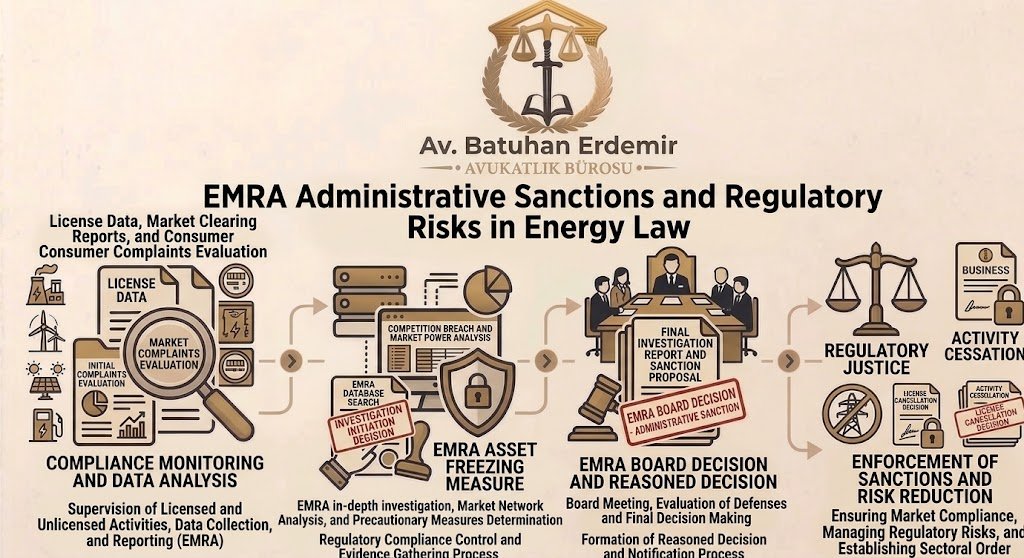
Energy (electricity, natural gas, petroleum, and LPG) is not merely a commercial commodity bought and sold for modern states; it is the direct cornerstone of economic independence, public order, and national security. The liberalization of energy markets and their opening to the private sector does not mean the market is left unchecked; on the contrary, it has necessitated the construction of a massive “regulation and supervision” network through upper boards such as the Energy Market Regulatory Authority (EMRA). Within this colossal ecosystem, EMRA administrative sanctions encountered by investors represent one of the most legally and financially challenging crises with the highest level of unpredictability.
Energy companies building power plants with multibillion-dollar investments, constructing distribution networks, or engaging in petroleum trade are caught between their profitability targets and EMRA’s mission of “cheap, uninterrupted, and secure energy supply.” The upper board’s authority to suddenly intervene in market dynamics, alter tariffs, or impose price ceilings constitutes the most critical regulatory risk item that must be managed and anticipated by the investor.
Tariff and License Crises in Electricity and Natural Gas Markets
Generation, transmission, supply, and distribution companies operating under the Electricity Market Law No. 6446 and the Natural Gas Market Law No. 4646 are strictly bound by the secondary legislation published by the Board. Aside from the bureaucratic obstacles companies face during licensing, license amendment, pre-license, or capacity increase processes, the retrospective alteration of tariff methodologies or formulas directly affects the Return on Investment (ROI) period, damaging free-market reliability.
In particular, sudden legislative changes made unilaterally by the administration regarding the Renewable Energy Resources Support Mechanism (YEKDEM) applications, capacity mechanisms, or eligible consumer limits can create a massive earthquake effect on company balance sheets.
The Destructiveness of Astronomical Fines and License Revocations
The sanctioning power utilized by EMRA while auditing the energy market goes far beyond classical administrative law; it is disproportionate and destructive enough to terminate the commercial existence of companies within seconds. Especially, EMRA administrative sanctions imposed pursuant to the Petroleum Market Law No. 5015 and the LPG Market Law No. 5307 often reach astronomical levels. Regardless of the nature of the violation or the concrete damage created, these fines are generally calculated proportionally based on the company’s “gross revenue” from the previous financial year.
Microscopic deviations in national marker levels, automation system malfunctions at gas stations, or technical (yet harmless) activities outside the scope of the license can be interpreted by the administration as intentional “smuggling” or “market-distorting actions.” Temporary suspensions, license revocations, and multimillion-lira fines imposed without establishing the concrete fault of the company or obtaining an effective defense are state-of-emergency practices that surrender capital to the arbitrariness of the administrative authority, deeply shaking the right to property and the freedom of enterprise.
Illicit Fuel Allegations and Facility Sealings
For distributors and dealers operating in the petroleum and LPG markets, administrative risk often turns into a fire that spreads to heavy criminal courts. Cyber interventions made to automation systems from the outside or discrepancies between physical inventory and cash register (Z-report) data are directly reported to the prosecutor’s office by Authority auditors under the accusation of “smuggling.”
With the evolution of the administrative process into a judicial criminal investigation, the sealing of gas stations or storage facilities and the prosecution of company executives demanding imprisonment come to the fore. Just as the annulment of the administrative fine in the administrative court can drop the smuggling accusation in the criminal court, an acquittal decision obtained from the criminal court is the most powerful weapon to prove the injustice of the license revocation. Therefore, the holistic management of the process is essential.
Technical and Rational Defense in Administrative Jurisdiction Against Regulatory Shocks
Against EMRA’s disproportionate sanctions and Board decisions that narrow the market, a flawless judicial review mechanism is operated—integrating not only legal norms but also energy economics, petrochemical engineering, and administrative law:
- Urgently obtaining “Stay of Execution” (Yürütmenin Durdurulması) decisions before the Administrative Courts against destructive administrative fines and license revocation procedures issued by the Board to prevent commercial paralysis before irreparable damages occur.
- Subjecting tariff methodologies, regulations, or price ceiling decisions (regulatory actions) published by EMRA—which unjustly narrow the profit margins of energy companies—directly to annulment actions before the Council of State (Danıştay) on the grounds of violation of law and property rights.
- In investigations initiated with allegations of illicit fuel or market manipulation, refuting the administration’s unilateral laboratory (e.g., TÜBİTAK) analyses with engineering expert opinions (arbitrator analyses) obtained from independent universities.
The defense undertaken in energy law and the stance taken against EMRA administrative sanctions is a struggle to prevent the bureaucratic dominance established by the state via the upper board from destroying the rationality of the free market and the legal security of the investor with the sword of administrative jurisdiction. To construct a strategic defense in your legal processes, you can contact us through the contact section of our website.
Legal Notice and Disclaimer
All articles, analyses, and legal evaluations contained on this website are provided for general informational purposes only and do not, under any circumstances, constitute a formal legal opinion, legal advice, or consultancy intended to be applied to a specific dispute or legal situation.
Due to the dynamic nature of legislation and the unique material characteristics of each concrete case, our firm accepts no liability for any loss of rights that may arise from actions taken or decisions made in reliance upon these texts.
You may contact us directly to have your legal problems resolved, to obtain a professional legal opinion based on your specific case file, or to schedule an appointment for verbal consultancy services.