
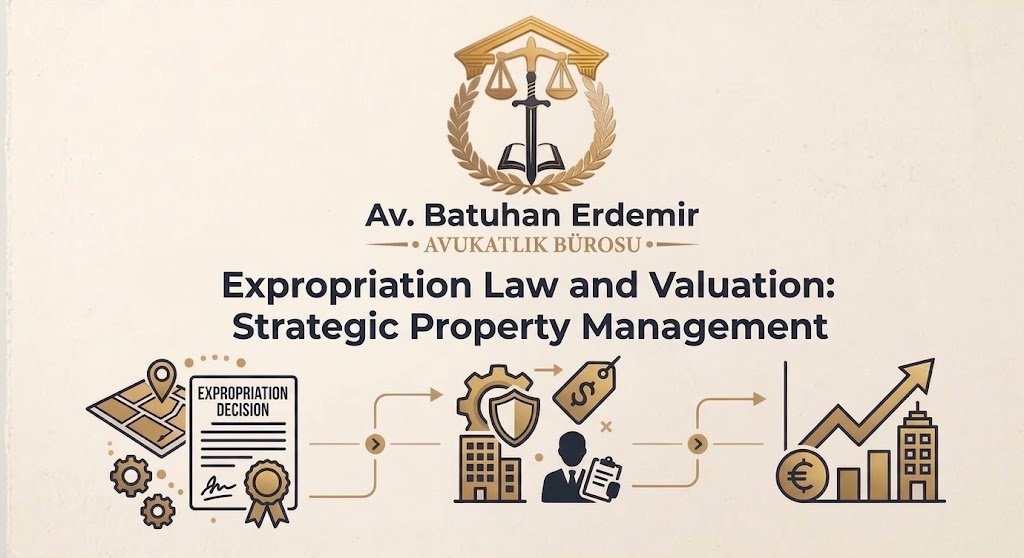
Expropriation Law and Valuation: Strategic Property Management
The right to property, guaranteed under Article 35 of the Constitution of the Republic of Turkey, is not absolute and unlimited in modern legal systems. In cases necessitated by social needs, macro-infrastructure projects (such as highways, dams, power transmission lines, and airports), or strategic public services, the state possesses the constitutional authority of “eminent domain.” This allows the state to seize privately-owned real estate, provided it pays the compensation in advance.
However, this process, which inherently means depriving an individual or an investing corporation of their real estate without their consent, is one of the most strictly regulated and bureaucratic areas where administrative law and property law intersect. Although the administration possesses discretionary power in declaring a “public interest/utility,” using this power disproportionately to harm the essence of property rights is legally unacceptable. At this exact juncture, expropriation law and valuation mechanisms serve as the most strategic judicial protection, balancing the state’s privilege to use public power against the real estate owner’s right to rational and fair compensation.
The Purchasing Procedure and Administrative Negotiations
Pursuant to the Expropriation Law No. 2942, when the administration decides to seize a property, it cannot directly file a lawsuit. Legally, it must first attempt a “purchasing procedure” (administrative negotiation). A valuation commission established by the administration invites the property owner to negotiate a price.
In practice, the amounts offered by administrations generally fall significantly below free-market values. Consequently, a failure to reach a consensus between the owner and the administration is the most common scenario. If the property owner does not attend this invitation or rejects the offer, the process is escalated to the oversight of the judicial system.
Expropriation Law and Valuation: Judicial Determination
Following the issuance of a non-conciliation report, the administration files a “Determination of Compensation and Registration Lawsuit” in the Civil Courts of First Instance. This lawsuit is the most critical phase, determining the transfer of ownership to the administration and the final compensation amount to be paid to the property owner.
The foundation of the legal defense conducted at this stage is directed toward the reports prepared by court-appointed expert committees. To ensure a rational and satisfactory compensation amount is blocked in the bank, the following valuation criteria must be subjected to strict legal scrutiny:
- Zoned Lands (Arsa): The valuation of lands within zoning plans is calculated using the “Precedent Comparison” (Market Approach) method. Against the administration’s strategy of presenting low-value and distant precedents to drive the price down, it is vital to present the court with up-to-date precedents that reflect the true market dynamics of the region.
- Agricultural Lands (Arazi): The valuation of agricultural lands is calculated using the “Net Income Method” (Income Capitalization Approach). Expert actuarial objections based on the region’s climatic features, irrigation capabilities, and the annual yield of planted crops directly maximize the compensation amount.
Urgent Expropriation (Article 27) and Legal Security Risks
The Article 27 regime, utilized in extraordinary situations determined by the President (especially for urgent energy and infrastructure projects) or national defense needs, is an exceptional procedure where property rights are most severely restricted.
While the normal process awaits the determination of compensation and negotiations, under the urgent seizure regime, the property is immediately confiscated after depositing a minimal amount determined by a superficial expert examination. The actual market value determination is left to a subsequent substantive lawsuit. This situation creates a severe cash flow and legal security crisis for foreign investors and property owners. Managing this crisis relies on legally compelling the administration to pay the massive difference, along with legal interest, in the ensuing substantive compensation lawsuit.
Annulment of Public Interest and the Right of Retrocession
The proactive legal practice conducted to protect the real estate owner in the field of eminent domain is not limited merely to increasing compensation:
- Annulment Lawsuits: If the public interest decision taken by the administration is unlawful in terms of authority, purpose, or subject (e.g., the project is not actually based on a rational infrastructure need), urgent annulment lawsuits are filed in Administrative Courts to halt the transaction.
- Right of Retrocession (Return): Although an exceptional route, if a property transferred to the public remains unused (left idle without any operations) in accordance with its intended purpose for 5 years, the property owner can exercise their “Right of Retrocession” (Article 23 of the Law) by returning the received compensation with interest within the legal timeframe to reclaim their real estate.
Rational defense in property disputes means preventing the state’s public power from disproportionately violating the constitutional rights of the individual or the investor. For strategic legal representation in administrative negotiation meetings, compensation increase lawsuits, urgent seizure crises, and annulment cases, you can contact us through the contact section of our website.
Legal Notice and Disclaimer
All articles, analyses, and legal evaluations contained on this website are provided for general informational purposes only and do not, under any circumstances, constitute a formal legal opinion, legal advice, or consultancy intended to be applied to a specific dispute or legal situation.
Due to the dynamic nature of legislation and the unique material characteristics of each concrete case, our firm accepts no liability for any loss of rights that may arise from actions taken or decisions made in reliance upon these texts.
You may contact us directly to have your legal problems resolved, to obtain a professional legal opinion based on your specific case file, or to schedule an appointment for verbal consultancy services.