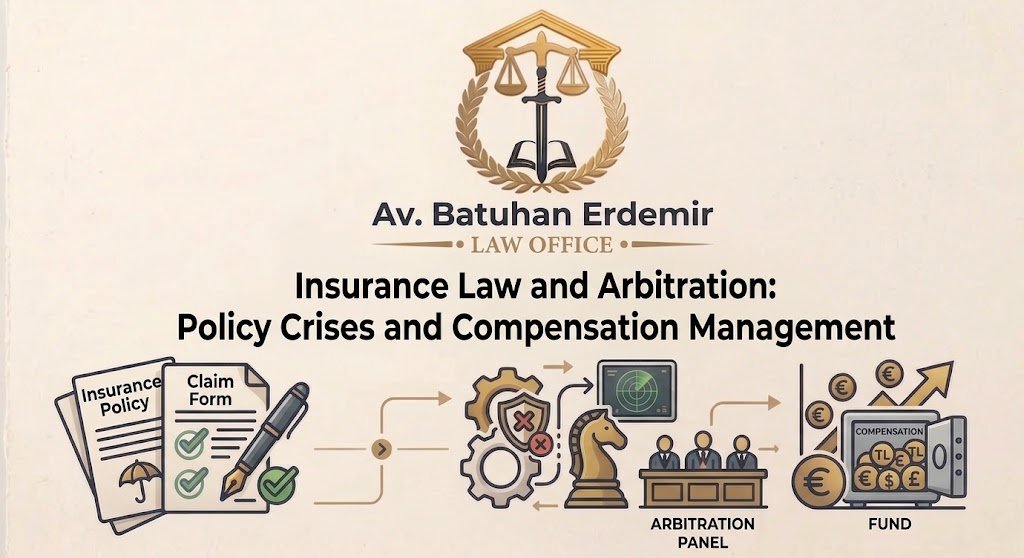
Insurance Law and Arbitration: Policy Crises and Compensation Management
Insurance relations represent the legal ground where the “financial security” purchased by individuals and massive corporations against disasters (fires, earthquakes, accidents, bankruptcies) either turns into reality or shatters as a bureaucratic illusion during a crisis. These commercial consensus mechanisms, where regular premiums are paid and no issues arise during times of peace, suddenly turn into an asymmetric conflict when a massive factory burns down or a severe workplace accident occurs.
Insurance law and arbitration processes constitute the most strategic area of commercial jurisprudence, where these crises—squeezed between the rejection reflexes of corporations wielding immense financial power and the rightful expectations of policyholders—are resolved with a rational and legal scalpel. Faced with the power of the issuing institution, the isolation of the party caught in the midst of a crisis necessitates an absolute and professional legal intervention.
The “Out of Coverage” Shield and Microscopic Exceptions in Insurance Law and Arbitration
Coverage offered with great ease during the signing of the policy often hits a wall of rejection when the risk materializes, citing reasons such as “breach of the duty of disclosure,” “events outside the scope of coverage,” or “gross negligence.” It is one of the most frequently encountered reflexes in commercial life for guaranteeing institutions to avoid payment by hiding behind microscopic “exception” (exemption) clauses and heavy bureaucratic conditions concealed within the texts, under the guise of preventing unjust enrichment.
Reports prepared by appointed loss adjusters following a damage notification may inherently carry a tendency to minimize costs. Technical determinations—such as whether the loss was a “natural disaster” (force majeure) or an “operational fault,” or whether a fire started from an “electrical short circuit” or “intentional arson”—dictate the fate of multi-million dollar payouts. At this point, the provisions of the Turkish Commercial Code No. 6102 (TCC) and the universal rule of interpretation, contra proferentem (interpretation against the drafter in favor of the insured), serve as the most potent legal weapons used to refute baseless rejection decisions.
Corporate Crises: Business Interruption and D&O Policies
Sustaining corporate existence in large-scale commercial crises depends on the strategic management of the dispute process. In conflicts arising from “Business Interruption” policies triggered when production halts due to reasons like fire, flood, or machinery breakdown, it is vital to secure a “Determination of Evidence” in Commercial Courts through counter-opinions obtained from independent universities and forensic accounting experts against unilateral adjuster reports.
Furthermore, within the scope of Directors and Officers Liability Insurance (D&O)—one of the most important safeguards of modern corporate governance—the corporate veil is secured by legally compelling the issuing company to cover defense costs and damages in the face of unjust compensation claims directed at board members.
Individual Grievances and Actuarial Compensation Calculations
Beyond corporate damages, in the event of “Bodily Injuries” (disability and fatality) resulting from traffic accidents, workplace disasters, or medical malpractice, the process must transcend mere moral suffering and transition into a mathematical compensation dimension.
Particularly in cases of permanent disability or loss of support, it is imperative that future earnings losses and lifelong care expenses are comprehensively calculated according to the strict rules of “Actuarial Science” (e.g., TRH-2010 mortality tables).
The Insurance Arbitration Commission and Strategic Dispute Resolution
Whether it is a corporate factory fire or an individual bodily injury file, alternative dispute resolution methods established under the Insurance Law No. 5684 should be preferred over the sluggish structure of state courts that can take years to establish justice in coverage disputes.
The legal defense practice in this field encompasses the following steps:
- Initiating fast-track tribunal proceedings (which conclude on average within 4 to 6 months) before the Insurance Arbitration Commission against unjust refusals to pay or “underpayment” (residual balance) decisions, thereby preventing commercial paralysis.
- Countering allegations of “intentional non-disclosure” by shifting the burden of proof through legal rules to determine whether the pre-contractual duty to inform and clarify was properly fulfilled by the underwriting company.
Defense in this sector is the art of recovering the value of the premiums paid by the individual or the company, along with legal interest, on a solid legal ground without falling victim to cold commercial calculations. For the rational resolution of your rejected claim files, underpaid compensations, and corporate policy disputes, you can contact our expert legal team through the contact section of our website.
Legal Notice and Disclaimer
All articles, analyses, and legal evaluations contained on this website are provided for general informational purposes only and do not, under any circumstances, constitute a formal legal opinion, legal advice, or consultancy intended to be applied to a specific dispute or legal situation.
Due to the dynamic nature of legislation and the unique material characteristics of each concrete case, our firm accepts no liability for any loss of rights that may arise from actions taken or decisions made in reliance upon these texts.
You may contact us directly to have your legal problems resolved, to obtain a professional legal opinion based on your specific case file, or to schedule an appointment for verbal consultancy services.