
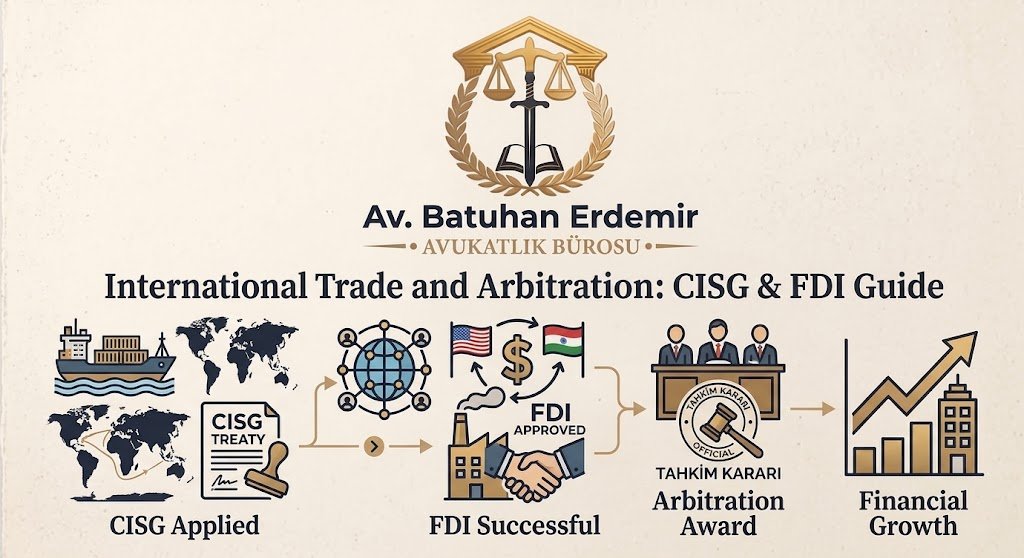
In today’s economic ecosystem where global capital transcends borders, international trade and arbitration is the fundamental legal mechanism that manages the inevitable collision of different legal systems, judicial sovereignties, and local commercial reflexes. In export and import processes, the parties’ attempts to impose their own national legislation (domestic law) on each other lead to a chaos of the “applicable law” (lex causae) in commercial disputes.
Beyond national regulations such as the Law on Private International Law and International Civil Procedure No. 5718 (MÖHUK), the United Nations Convention on Contracts for the International Sale of Goods (CISG), built to eliminate this deep chaos and bring uniform rationality to global commerce, is regarded today as the constitution of global trade. When the risk passes from the seller to the buyer (integration with Incoterms rules), the boundaries of the delivery obligation, and cases of “fundamental breach” of contract must be subjected to judicial review not with the narrow vision of local courts, but entirely through these universal rules dedicated to the dynamics of international trade.
Foreign Direct Investments (FDI), Expropriation, and Sovereign Conflict
Going one step beyond the cross-border sale of goods, entering the territory of a foreign country with massive capital and long-term projects (Foreign Direct Investments – FDI) elevates the dimensions of legal risk to a macro level. The Host State suddenly changing its tax regime based on its sovereign rights and political conjuncture, canceling mining/energy licenses, or resorting to direct or indirect expropriation means absolute destruction for foreign capital.
These unilateral administrative acts carried out by the state under the guise of “public interest” or “national security” are characterized as direct violations of the “Fair and Equitable Treatment” and “Full Protection and Security” principles guaranteed by Bilateral Investment Treaties (BITs). Ensuring that global capital is not crushed against the state’s absolute regulatory authority (police powers) is only possible by donning the rational armor offered by international public law.
Managing Commercial Risks: Letters of Credit (L/C) and Bank Guarantees
In cross-border commercial relations, the fulfillment of payment obligations harbors as massive a risk as the delivery of goods. The seller’s fear of shipping goods and not getting paid, and the buyer’s fear of paying and not receiving the goods, are resolved through “Letter of Credit” (L/C) mechanisms subject to UCP 600 rules drafted by the International Chamber of Commerce (ICC).
However, a single typographical error (discrepancy) in L/C documents or the unjust liquidation (claim for payment) of international Bank Guarantees can cause millions of dollars in damages. In these disputes, it is mandatory to follow an aggressive strategy based on international banking law norms, within the framework of banks’ obligation to examine documents strictly and the “principle of independence.”
The Arbitration Mechanism in Macro Disputes and Global Judicial Practice
Expecting disputes arising in multibillion-dollar projects to be resolved in the local courts of the host state or one of the parties is contrary to the nature of the “impartiality” principle. For the rational resolution of these massive disputes, a superior mechanism, supported by the International Arbitration Law No. 4686 and universal conventions, operates outside the traditional judicial system:
- Commercial Arbitration: Allegations of defective performance, default, and force majeure arising from commercial sales contracts are resolved with technical precision by independent arbitral tribunals before international arbitration centers such as ICC, LCIA, or ISTAC.
- Investment Arbitration (ICSID): Unjust property seizures and contract violations imposed by states on foreign investors are taken to arbitration before ICSID (International Centre for Settlement of Investment Disputes) under the World Bank, effectively putting the sovereign state in the defendant’s seat in the international arena.
- Enforcement Processes: Favorable decisions (Arbitral Awards) obtained from international arbitral tribunals are practically collected by seizing (enforcing against) the assets of the defendant state or institution anywhere in the world, within the framework of the provisions of the 1958 New York Convention.
The defense conducted in the field of international trade and arbitration is the construction of justice at a global standard, with impartiality and the highest level of rationality, transcending the boundaries of local politics and bureaucracy. To draft your global commercial contracts, protect your cross-border investments, and strategically manage your arbitration processes, you can contact our expert team through the contact section of our website.
Legal Notice and Disclaimer
All articles, analyses, and legal evaluations contained on this website are provided for general informational purposes only and do not, under any circumstances, constitute a formal legal opinion, legal advice, or consultancy intended to be applied to a specific dispute or legal situation.
Due to the dynamic nature of legislation and the unique material characteristics of each concrete case, our firm accepts no liability for any loss of rights that may arise from actions taken or decisions made in reliance upon these texts.
You may contact us directly to have your legal problems resolved, to obtain a professional legal opinion based on your specific case file, or to schedule an appointment for verbal consultancy services.