
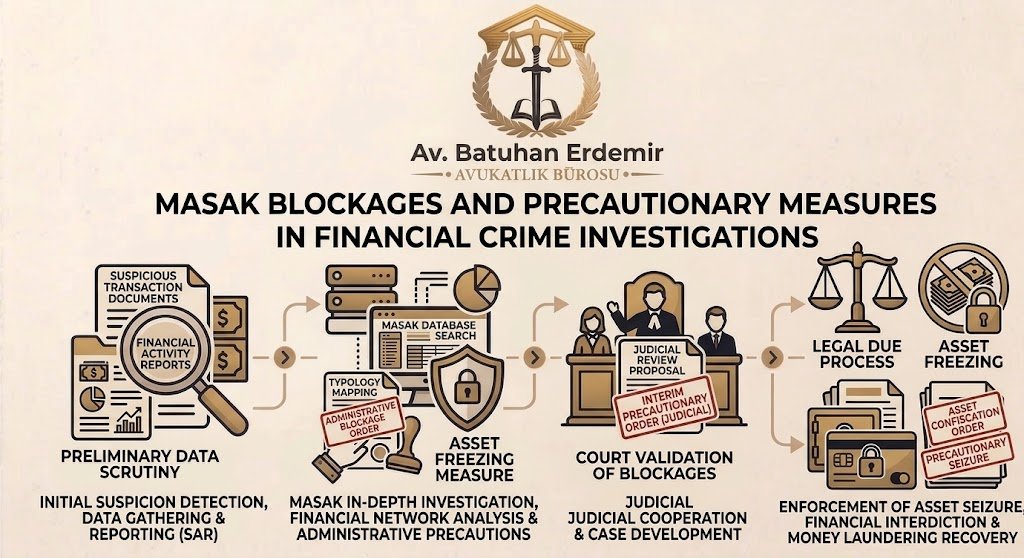
As the speed of capital movements increases with the digitalizing global economy, state audit and surveillance mechanisms over the financial system have entered an unprecedented tightening process. In this context, MASAK blockages and precautionary measures encountered suddenly by companies and investors constitute one of the most sensitive and destructive administrative-judicial crises of criminal proceedings, conducted within the framework of Law No. 5549 on Prevention of Laundering Proceeds of Crime.
In these disputes, where allegations of tax irregularities, illegal betting, anti-money laundering (AML), or suspicions of terrorism financing are at the center, bank records, crypto asset transfers, and commercial contracts must be passed through a meticulous legal filter. The foundation of the legal process is formed not by mere police reports, but by the objective analysis of this complex financial data within the framework of criminal law norms and forensic accounting principles. These restrictions placed suddenly on company accounts represent a strategic crisis that cuts off a company’s cash flow within hours, bringing its commercial life to a standstill.
Suspicious Transaction Reports (STR) and the 7-Day Suspension Process
The starting point of MASAK (Financial Crimes Investigation Board) blockages is generally the “Suspicious Transaction Reports” (STR / ŞİB) filed by banks, payment institutions, or cryptocurrency exchanges. Transactions flagged by algorithms as unusual (high-volume, frequent, or unexplained international fund outflows) are automatically reported to MASAK.
Pursuant to Article 19/A of Law No. 5549, MASAK or the relevant Ministry has the authority to temporarily “suspend” the suspicious transaction for seven (7) working days. This stage is a purely administrative process. However, the biggest mistake company executives and investors make is losing time by assuming this blockage is a temporary systemic error of the bank. In reality, this 7-day period is the most critical timeframe during which the defense mechanism must be activated immediately before the administrative measure turns into a heavy criminal investigation (and a prosecutorial seizure decision).
Seizure under CMK Article 128 and the Principle of Proportionality
The most fundamental legal risk encountered in financial investigations is the administrative suspension measure exceeding the reasonable period and transforming into an official “Seizure” (El Koyma) procedure under Article 128 of the Criminal Procedure Code No. 5271 (CMK) upon the request of the Chief Public Prosecutor’s Office and the decision of the Criminal Judgeship of Peace.
In accordance with the “principle of proportionality,” which is one of the most fundamental universal rules of criminal procedure, and the constitutional right to property, the blockages placed on accounts must be strictly limited to the amount under the suspicion of the attributed crime. However, in practice, it is observed that wholesale blockages are placed on all commercial accounts of companies used for salary, tax, and supplier payments without relying on concrete evidence.
Against these general, limitless, and disproportionate precautionary decisions that paralyze the commercial life of companies, legal remedies (objections) must be applied without delay before the Criminal Judgeships of Peace. Such restrictions on corporate accounts should not be severed from the ordinary course of commercial activity and directly accepted as a confession or imputation of a crime.
Crypto Assets and Compliance Risk in International Trade
Today, MASAK blockages and precautionary measures are not limited solely to the traditional banking system; they also directly target cross-border fund transfers of companies engaged in international trade and cold/hot wallet assets in cryptocurrency exchanges.
Blockchain transfers resorted to by companies for corporate risk management (hedging) or import payment purposes instantly create a blockage risk when the necessary “Know Your Customer” (KYC) and “Anti-Money Laundering” (AML) compliance processes are not established on a legal basis. Lifting blockages on such next-generation financial assets requires an elite expertise that can fuse both IT law and capital markets legislation in the same melting pot.
Strategic Defense and Evidence Examination in Financial Investigations
In files with heavy sanctions such as asset freezing and seizure, the defense mechanism must go beyond mere administrative objections—like submitting a standard petition to the bank branch—and transform into a technical judicial proof process. In the legal process conducted to lift MASAK blockages and precautionary measures;
- Whether the legal conditions of the applied precautionary decision (strong suspicion of crime and concrete evidence) have materialized in the concrete case,
- The legitimacy of commercial contracts, customs declarations, and invoices forming the basis of financial transactions is proven at forensic accounting standards,
- The absolute absence of a legal “causal link” (causality) between the money traffic deemed suspicious and the attributed crime is meticulously examined.
To prevent companies, executives, and investors from facing an unjust commercial destruction under disproportionate financial measures, a rational defense practice based not only on legal arguments but also on high financial literacy is put forward. To protect your company’s commercial survival in the face of unexpected account blockages and financial criminal investigations, you can contact us through the contact section of our website.
Legal Notice and Disclaimer
All articles, analyses, and legal evaluations contained on this website are provided for general informational purposes only and do not, under any circumstances, constitute a formal legal opinion, legal advice, or consultancy intended to be applied to a specific dispute or legal situation.
Due to the dynamic nature of legislation and the unique material characteristics of each concrete case, our firm accepts no liability for any loss of rights that may arise from actions taken or decisions made in reliance upon these texts.
You may contact us directly to have your legal problems resolved, to obtain a professional legal opinion based on your specific case file, or to schedule an appointment for verbal consultancy services.