
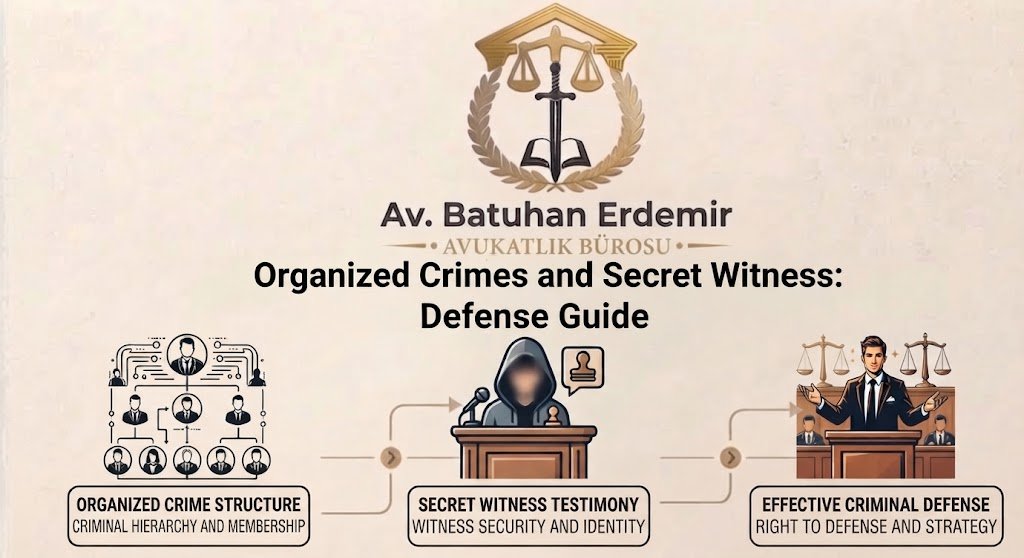
Organized Crimes and Secret Witness: Defense Guide
Allegations of “establishing an organization for the purpose of committing crimes,” regulated under Article 220 of the Turkish Penal Code No. 5237 (TCK), constitute the most severe, complex, and liberty-restricting judicial processes in the modern criminal justice system. In practice, this accusation is frequently constructed as an administrative tool to increase the penalty limit of the primary alleged crime (e.g., fraud, customs smuggling, tax irregularities, or bid-rigging) and to impose harsher precautionary measures on suspects (such as prolonged pre-trial detention, wiretapping, and asset confiscation/seizure).
Characterizing coincidental encounters, legal corporate organizations, ordinary commercial relations, or kinship ties as an “organization” without a concrete criminal intent and a strict hierarchy is a legal fallacy that directly damages the presumption of innocence. Protecting an individual’s liberty and a company’s commercial survival in such massive, multi-defendant indictments is only possible not by merely reading statutory articles, but by refuting thousands of pages of HTS (Historical Traffic Search) records, wiretap transcripts, and the chain of evidence with a mathematical engineering vision.
Organized Crimes and Secret Witness: Hierarchical Structure and the Intent to Commit Crimes
For a structure to be considered an “organization” in the context of criminal law, there are strict conditions established by the precedents of the Supreme Court of Appeals (Yargıtay) Penal General Assembly. Having a minimum of three members is not sufficient on its own; there must be a “hierarchy” based on a superior-subordinate relationship, a “continuity” in the intent to commit crimes, and the structure must possess the “equipment” capable of committing the intended crimes.
The internal departmental management of companies (the hierarchy of CEO, CFO, Managers) cannot be interpreted as a criminal syndicate hierarchy. Criminalizing legal activities aimed at a common commercial goal or a periodic tender as “criminal organization activity” is a grave error. The first step of a rational legal defense is to prove the sharp distinction between these legal associations and an illegal organizational structure to the court panel using financial and corporate evidence (commercial registry records, internal directives), thereby demonstrating that the material elements of the crime have not materialized.
Organized Crimes and Secret Witness Testimonies
One of the areas most susceptible to procedural errors in criminal trials is the files where organized crimes and secret witness testimonies intertwine. Abstract statements given by witnesses whose identities are concealed—often in exchange for animosity or personal gain—can drag innocent individuals into a spiral of detention that lasts for years.
However, according to the Turkish Criminal Procedure Code No. 5271 (CMK) and the standards of the European Court of Human Rights (ECtHR), the testimony of an anonymous witness, whom the defendant or the defense attorney is unable to directly question and cross-examine in the courtroom, cannot stand alone as the basis for a conviction. The fundamental strategy in defense practice is to refute the abstract allegations of the anonymous witness with objective “material facts” such as HTS logs, hotel records, bank receipts, and camera footage, completely excluding these slanders from the file.
HTS Analysis, Base Station Intersections, and Wiretaps
In multi-defendant cases, the skeleton of the indictments is generally formed by communication data based on out-of-context telephone wiretaps (transcripts) and mere base station intersections (HTS analysis).
Being in the same geographical area (base station intersection) or engaging in commercial/social phone calls within the ordinary course of life cannot be accepted as evidence of organizational contact unless supported by rational and material corroborating evidence. Furthermore, all audio recordings obtained by violating the legal durations, extension conditions, and legal procedures of “Detection, Wiretapping, and Recording of Communication” decisions under CMK Article 135 are considered “unlawful evidence.” The attorney’s duty at this point is to ensure the removal of procedurally flawed wiretaps from the file and to prevent ordinary commercial jargon from being interpreted by the prosecution as “organizational code words.”
Individualization in Omnibus Trials and Legal Offensive
The defense mechanism implemented in these trials, which crush individuals under massive indictments, requires absolute analytical rigor. The basic principle is to meticulously individualize the actions of the defendants in omnibus trials, breaking the fallacy of “collective responsibility (collective punishment).”
The position, actions, and criminal intent (mens rea) of each defended client must be isolated from the other defendants, severing the causal link. To protect corporate reputation and restore liberty, strategic judicial representation against irregular wiretaps, abstract testimonies, and erroneous hierarchy constructs is imperative. For representation in objecting to organized crimes and secret witness allegations, analyzing HTS data, and defending company executives, you can contact our expert heavy penal team through the contact section of our website.
Legal Notice and Disclaimer
All articles, analyses, and legal evaluations contained on this website are provided for general informational purposes only and do not, under any circumstances, constitute a formal legal opinion, legal advice, or consultancy intended to be applied to a specific dispute or legal situation.
Due to the dynamic nature of legislation and the unique material characteristics of each concrete case, our firm accepts no liability for any loss of rights that may arise from actions taken or decisions made in reliance upon these texts.
You may contact us directly to have your legal problems resolved, to obtain a professional legal opinion based on your specific case file, or to schedule an appointment for verbal consultancy services.