
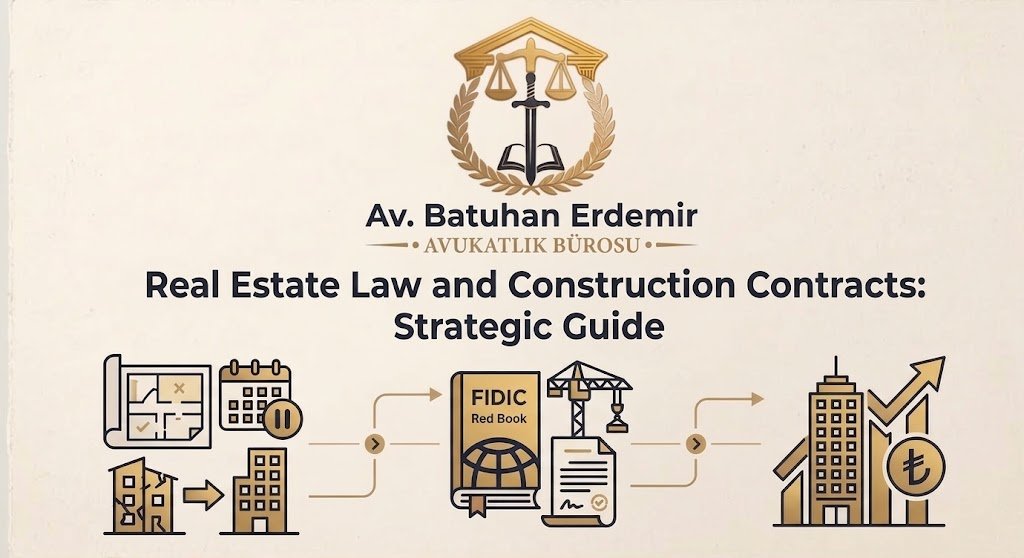
Real Estate Law and Construction Contracts: Strategic Guide
The real estate and construction sector is the most dynamic commercial arena where massive billions of liras in investments, the fundamental right to housing, and international capital intersect. However, these macro-scale projects are perpetually prone to major crises due to market fluctuations, sudden cost escalations, complex administrative regulations, and highly technical disputes.
At this juncture, real estate law and construction contracts serve as the most strategic risk management discipline, protecting the constitutional property rights of individuals while preventing colossal investments from turning into idle legal ruins. Whether it is a local urban renewal project or a multinational FIDIC tender, the protection of property and capital is only possible through an uncompromising contractual architecture and an aggressive administrative-judicial practice.
Real Estate Law and Construction Contracts: Urban Renewal Crises
The Law No. 6306 on the Transformation of Areas under Disaster Risk inherently aims to secure the right to life. In practice, however, this process can mutate into a tool for contractor firms or majority shareholders to dispossess the minority. Creating a de facto eviction pressure through administrative sanctions, such as cutting off electricity, water, and natural gas, is a severe violation of the constitutional right to housing.
The legal heart of these disputes lies in the “Risky Building Assessment Reports.” In many cases, these reports are manipulated based on the commercial value of the land rather than measuring the true static condition of the building. Against improperly extracted core samples or incomplete reinforcement assessments, filing annulment lawsuits and urgently obtaining “Stay of Execution” decisions in Administrative Courts is the sole defense for property rights.
Land Share Construction Contracts and Contractor Default
Contracts executed between landowners and construction companies constitute a massive capital partnership. However, rising material costs or the financial bottleneck of the contractor often result in projects being abandoned midway at the construction site. The contractor missing the delivery date (default) or delivering the building with incomplete/defective workmanship is a severe violation of the “flawless performance of the work” rule under the Turkish Code of Obligations No. 6098.
In the event of contractor default, it is vital to immediately terminate the contract (either retroactively or prospectively), remove the annotations placed on the title deed, and liberate the land. “Hidden defects” (latent defects), such as static deficiencies in load-bearing systems or insulation flaws, must be legally recorded through independent “Determination of Evidence” reports from university engineering faculties before the statute of limitations expires.
Pre-emption Right (Right of First Refusal) and Collusion Traps
In properties subject to joint ownership under the Turkish Civil Code No. 4721, if a shareholder sells their share to a third party without consent, the “Pre-emption Right” (Right of First Refusal) is triggered for the other shareholders. The biggest fraud frequently encountered in commercial life is showing the sale at a deceptively low price at the title deed registry, despite the share being sold to a third party for a high amount, in order to hinder other shareholders from exercising this right.
These collusive (sham) sale prices create a massive financial trap for those wishing to exercise their pre-emption right. The rational legal solution is to demand a “Determination of Fair Market Value” (through court discovery and expert examination) to reveal the true price and exercise the right over this equitable amount.
FIDIC EPC Contracts: Risk Allocation in International Construction
For international power plants, refineries, and infrastructure investments, EPC (Engineering, Procurement, and Construction – Silver Book) contracts, the strictest derivative of FIDIC standards, are predominantly preferred. In the EPC model, the entire risk from the design to the construction of the facility is transferred to the Main Contractor under the principle of “lump-sum and single-point responsibility.”
Under the pressure of a Fixed Price and a strict Time for Completion, the contractor is presumed to have foreseen ground anomalies or climatic difficulties. The most critical threshold for Claim Management in these projects is the strict “28-day notice period” stipulated in the contract. Missing this deadline leads to the absolute forfeiture of the contractor’s rights to extensions of time and additional compensation.
For strategic legal representation regarding urban renewal disputes, contractor defaults, pre-emption lawsuits, or international FIDIC contracts, you can contact us through the contact section of our website.
Legal Notice and Disclaimer
All articles, analyses, and legal evaluations contained on this website are provided for general informational purposes only and do not, under any circumstances, constitute a formal legal opinion, legal advice, or consultancy intended to be applied to a specific dispute or legal situation.
Due to the dynamic nature of legislation and the unique material characteristics of each concrete case, our firm accepts no liability for any loss of rights that may arise from actions taken or decisions made in reliance upon these texts.
You may contact us directly to have your legal problems resolved, to obtain a professional legal opinion based on your specific case file, or to schedule an appointment for verbal consultancy services.