
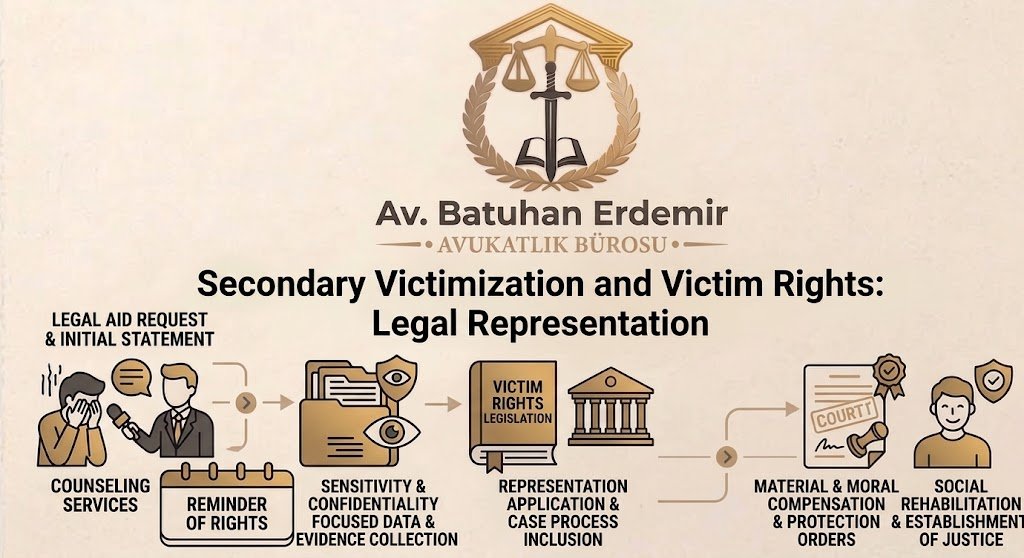
Secondary Victimization and Victim Rights: Legal Representation
Historically, the dogmatics of modern criminal law have been primarily built upon the balance of power between the “state’s monopoly on punishment” and the “defendant’s right to defense.” Located right at the epicenter of this dual equation, the party who has actually been subjected to an unjust act and is experiencing physical, psychological, or massive economic trauma is often reduced to being merely “criminal evidence” or a passive “complainant” during the judicial process.
Long waits in courthouse corridors, heavy penal trials lasting for years, the bureaucratic sluggishness of the prosecution, and being forced to repeatedly confront the perpetrator in the courtroom deepen the initial trauma experienced by the individual or company, turning into a structural psychological violence termed “Secondary Victimization” in legal literature. The sole duty of a corporate and rational legal system is not merely to listen to the complainant, but to strictly prevent violations of secondary victimization and victim rights through rigorous procedural rules, and to immediately restore usurped dignity and property through judicial processes (restorative justice).
Secondary Victimization and Victim Rights: Status of Intervener and Deepening the Investigation
Representing the injured party, the relatives of the deceased, or defrauded legal entities (companies) in criminal files requires a legal vision that is at least as aggressive, proactive, and analytical as criminal defense representation. Under Article 237 et seq. of the Turkish Criminal Procedure Code No. 5271 (CMK), being included in the case with the status of “intervener (müdahil)” means stepping out of being a passive observer and becoming an active subject steering the trial.
In practice, the prosecution authority may remain superficial in collecting evidence due to workload. Pursuing uncollected digital evidence (HTS, log records) during the investigation phase, ensuring the return of defectively constructed indictments from the court, and preventing the perpetrator’s efforts to hide assets or tamper with evidence (cover-up) is only possible through an expert “Representation of the Intervener” institution. Not deeming the activities conducted by the prosecution on behalf of the public as sufficient, the alleged crime must be transformed into an indisputable material truth before the court panel through independent expert opinions obtained from universities (CMK Art. 67/6) and special investigative techniques.
Secondary Victimization and Victim Rights: Cross-Examination
In the face of the devastation created by the crime, the atmosphere in the courtroom must absolutely be prevented from creating a new trauma (revictimization) on the complainant. In the strategic representation executed, procedural safeguards are operated as follows:
- Courtroom and Forensic Interview Rooms (AGO): Particularly in files involving crimes against sexual inviolability, domestic violence, or highly traumatic intentional homicide, psychological safety is ensured by strictly demanding the application of SEGBIS (Audio-Visual IT System) or the Ministry of Justice Forensic Interview Rooms (AGO) facilities, which prevent the party from coming face-to-face with the perpetrator.
- Protection Shield in Cross-Examination: Against “psychological pressure”-focused questions directed by defense attorneys during the hearing to wear down, manipulate, or contradict the complainant, the boundaries of the interrogation are drawn by immediately raising procedural objections under CMK Article 201.
- Precautionary Measures: Against the possibility of the perpetrator’s release, procedures such as restraining orders, judicial control, travel bans, and placing an injunction on the perpetrator’s assets (to prevent them from being smuggled) are urgently requested from the court.
Restorative Justice and Compensation (Tort) Processes
The legal struggle waged for those harmed by a crime does not end merely with sending the perpetrator to prison; the ultimate goal is the “Restorative Justice” approach, which encompasses the compensation of all material and moral damages down to the last penny.
A qualified and finalized conviction verdict to be obtained from Heavy Penal or Criminal Courts of First Instance constitutes an unshakable foundation for massive “Material and Moral Damages” lawsuits (tort liability) to be filed in Civil Courts immediately following the criminal case. For this reason, every single piece of evidence and defendant confession in the criminal file must be strategically recorded in the minutes in a way that builds the infrastructure (causal link) of the future compensation lawsuit. Through this strategic integrity, secondary victimization and victim rights are guaranteed; justice ceases to be a favor from the state and becomes the most fundamental acquisition of the individual.
For professional legal representation in intervener processes, objections to indictments, cross-examination management, and compensation claims, you can contact our expert criminal law team through the contact section of our website.
Legal Notice and Disclaimer
All articles, analyses, and legal evaluations contained on this website are provided for general informational purposes only and do not, under any circumstances, constitute a formal legal opinion, legal advice, or consultancy intended to be applied to a specific dispute or legal situation.
Due to the dynamic nature of legislation and the unique material characteristics of each concrete case, our firm accepts no liability for any loss of rights that may arise from actions taken or decisions made in reliance upon these texts.
You may contact us directly to have your legal problems resolved, to obtain a professional legal opinion based on your specific case file, or to schedule an appointment for verbal consultancy services.