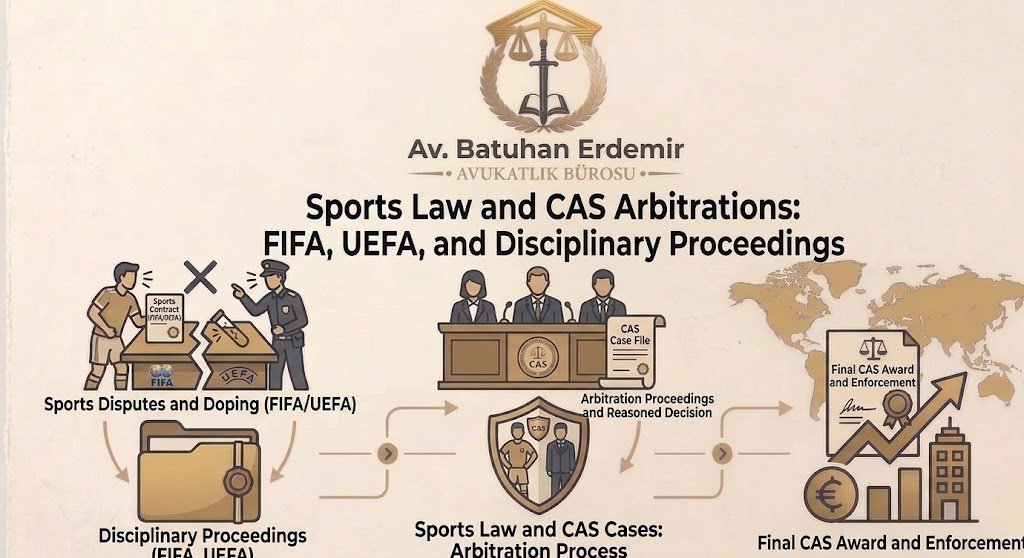
Sports law and CAS arbitrations is a field where billions of dollars in broadcasting rights, global sponsorship contracts, and massive club budgets are managed. At the core of this colossal ecosystem, the labor and image of the professional athlete stand as the most valuable “financial asset” exchanged between clubs and international representation agencies. However, the legal oversight of this massive economic volume is entrusted not to traditional state courts, but to independent and technical disciplinary bodies (such as Arbitration Committees and Dispute Resolution Chambers) established internally by national federations.
Pursuant to Article 59 of the Constitution of the Republic of Turkey, decisions rendered by governing federations regarding athletic administration and discipline are strictly subject to mandatory tribunal proceedings, and their awards are final. Shaped by lex specialis such as the Turkish Football Federation (TFF) Legislation No. 5894, sports law and CAS arbitrations constitute a highly niche area of expertise where career-ending bans or unjust contract terminations are resolved swiftly and under specific regulations, entirely independent of the slow-functioning processes of local courts.
Doping Allegations, WADA Rules, and “Strict Liability” in Sports Law and CAS Arbitrations
The most traumatic area of competitive litigation, where legal defense is the most arduous, involves doping proceedings conducted under the rules of the World Anti-Doping Agency (WADA). The “presumption of innocence,” the cornerstone of traditional criminal jurisprudence, has effectively been shifted to a different dimension in international athletic discipline, adopting the principle of “strict liability.”
Accordingly, the mere presence of a prohibited substance in an athlete’s bodily specimen is sufficient for an anti-doping rule violation. Before disciplinary tribunals, the burden of proof rests entirely on the defense to scientifically establish that the prohibited substance entered the body “without their fault or negligence” (e.g., through a mislabeled, contaminated nutritional supplement). The process of proving the absence of intent to cheat via forensic medicine, pharmacological reports, and polygraph tests is the heaviest technical defense waged to salvage the honor of a career.
Professional Player Contracts and Termination Without Just Cause
Contracts signed between clubs and professional athletes involve dynamics far more complex than a standard employment agreement. Disputes frequently arise over unpaid wages, the player being unjustly excluded from the first-team squad and deprived of training rights (mobbing), or the unilateral “termination without just cause” by the club.
In these moments of crisis, strategic claims filed before local National Dispute Resolution Chambers (NDRC) or directly before international authorities (FIFA DRC – Dispute Resolution Chamber) not only ensure the full collection of compensation but can also expose clubs to severe sporting sanctions, such as a transfer ban.
Lausanne-Based Tribunal Proceedings and International Practice
Faced with disciplinary and dispute decisions rendered by local federations or international confederations (FIFA, UEFA, etc.), the ultimate sanctuary for a club or professional athlete is the Court of Arbitration for Sport (CAS) located in Lausanne, Switzerland. The international strategy executed within this elite judicial mechanism encompasses the following stages:
- Appeal Proceedings: Filing urgent appeal cases before the Tribunal against unjust terminations, compensation rulings, or disciplinary sanctions issued by local federation boards, seeking their annulment under international standards in light of the Swiss Code of Obligations and FIFA Regulations.
- Training Compensation and Solidarity Mechanism: Claiming and collecting the “Training Compensation” and “Solidarity Mechanism” contributions rightfully owed to grassroots and academy clubs as a result of international transfers before FIFA.
- Financial Fair Play (FFP) Defenses: Overturning point deductions, exclusion from European competitions, or transfer bans imposed on clubs under UEFA’s FFP/Financial Sustainability criteria by bringing legal rationality to the table with independent international audit reports.
- Annulment of Representation Agreements: Invalidating disproportionate penalty clauses and lifelong, unilateral commission articles in representation (agency) contracts signed by athletes, strictly based on universal commercial norms.
Defense in the athletic sector means utilizing judicial power to prevent a career built on years of physical and mental sacrifice—or millions of dollars in club investments—from being unjustly erased by erroneous boardroom disciplinary decisions. For professional representation in competitive disputes, tribunal proceedings, and contract crises, you can contact our international legal team through the contact section of our website.
Legal Notice and Disclaimer
All articles, analyses, and legal evaluations contained on this website are provided for general informational purposes only and do not, under any circumstances, constitute a formal legal opinion, legal advice, or consultancy intended to be applied to a specific dispute or legal situation.
Due to the dynamic nature of legislation and the unique material characteristics of each concrete case, our firm accepts no liability for any loss of rights that may arise from actions taken or decisions made in reliance upon these texts.
You may contact us directly to have your legal problems resolved, to obtain a professional legal opinion based on your specific case file, or to schedule an appointment for verbal consultancy services.