
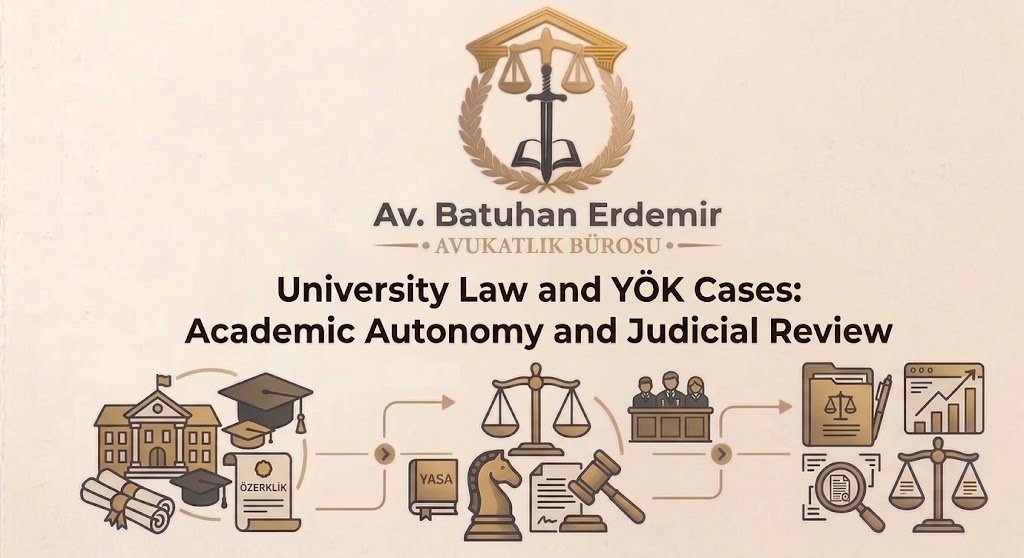
Universities are supposed to be sacred fortresses of science where universal knowledge is produced, critical thinking flourishes, and merit is observed at the highest level. However, in practice, they are often crushed under the heavy pressure of centralized bureaucracy and administrative tutelage. Stepping in precisely at this point, university law and YÖK cases serve as the most critical judicial defense shield, protecting the academic freedom, dignity, and constitutional rights of academics and students against the arbitrariness of the administration.
The rigid structure introduced by the Higher Education Law No. 2547 and the mechanisms of the Council of Higher Education (YÖK) unfortunately open the door to arbitrariness in a wide range of areas, from academic appointments to disciplinary investigations. Denying a scientist the title of associate professor or professor—earned through decades of hard work—due to subjective jury reports or personal motives, or suppressing the freedom of thought of a student or academic under the guise of discipline, constitutes the most fundamental existential crisis of modern higher education law.
Associate Professorship Exams, ÜAK Decisions, and Ethical Violation Accusations
During associate professorship applications, which are the most challenging curve of an academic career in Turkey, the reports prepared by juries appointed by the Interuniversity Board (ÜAK) can frequently drift away from scientific objectivity. Unfairly deeming a candidate’s publications “insufficient” or, even more severely, bringing an academic career to the brink of destruction through baseless “ethical violation” (plagiarism, phantom authorship, salami slicing) accusations are among the most frequently encountered disputes in the practice of university law and YÖK cases.
In annulment actions to be filed before the administrative judiciary in such situations, it is essential to refute subjective jury reports and unjust ethical violation decisions with expert arbitrator opinions obtained from independent universities (different academic departments). This legal struggle strictly prevents academic labor from being sacrificed to the personal initiative or hostility of an administrative jury member.
Tailor-Made Academic Postings and the Violation of Merit
One of the practices that most damages academic autonomy and merit in universities is “tailor-made academic job postings” (kişiye özel ilanlar). It is blatantly unlawful to add specific and restrictive special conditions to an open position for an assistant professor, associate professor, or professor that describe a “predetermined candidate” rather than a genuine scientific need of the faculty or institute.
These custom-tailored criteria, which violate the constitutional principles of equality and merit, can be annulled before the Administrative Courts. During the litigation process, the bureaucratic barricades in front of the deserving candidate are destroyed by exposing through technical reports that the announced position does not meet the general needs of the department and violates objective competitive conditions.
Disciplinary Investigations and the “Dismissal from Public Service” Battles
Disciplinary investigations conducted by university rectorates or deanships are often far removed from the fundamental universal principles of criminal law (legality in crime and punishment, the right to defense, appointment of an impartial investigator). Unjust investigations initiated by administrative mechanisms to silence critical voices, apply academic mobbing, or purge staff can result in severe sanctions causing irreparable damages, such as “dismissal from public service” (ihraç).
In annulment actions filed before Administrative Courts and the Council of State (Danıştay), refuting procedural irregularities in investigations, hostile or biased commission reports, and baseless allegations with concrete evidence is the only way to protect academic dignity and the guarantees of public servants.
Administrative Courts and Stay of Execution Mechanisms
In disputes within university law, time is the most critical factor. The legal struggle of an academic unfairly denied a position, a researcher whose associate professorship is blocked, or a student unlawfully dismissed cannot be sacrificed to prolonged litigation processes.
Obtaining “Stay of Execution” (Yürütmenin Durdurulması) decisions, which is the sharpest weapon of administrative law under the Administrative Procedure Law No. 2577 (IYUK), is of vital importance in terms of preventing irreparable damages. The strategic process carried out encompasses the following stages:
- Annulment of Merit Violations: Exposing and annulling custom-tailored academic criteria (non-objective conditions) that clearly violate the principle of merit in academic appointments before the administrative judiciary through technical reports.
- Halting Disciplinary Penalties: Suspending the execution of administrative sanctions on the grounds that the right to defense was restricted during the disciplinary investigation, the investigator violated the principle of impartiality, or there was a disproportionality between the act and the penalty.
- Student Rights and Exam Disputes: In student disciplinary penalties or exam/grading (material error) disputes, documenting the academic injustice through expert examinations to guarantee the student’s right to education.
Defense in university law means decisively putting an end, through judicial power, to the suffocation of scientific freedom, academic conscience, and merit in the shadow of bureaucratic tutelage and arbitrary administrative decisions. To defend your merit on a legal basis in the academic and administrative disputes you experience, you can contact our expert team through the contact section of our website.
Legal Notice and Disclaimer
All articles, analyses, and legal evaluations contained on this website are provided for general informational purposes only and do not, under any circumstances, constitute a formal legal opinion, legal advice, or consultancy intended to be applied to a specific dispute or legal situation.
Due to the dynamic nature of legislation and the unique material characteristics of each concrete case, our firm accepts no liability for any loss of rights that may arise from actions taken or decisions made in reliance upon these texts.
You may contact us directly to have your legal problems resolved, to obtain a professional legal opinion based on your specific case file, or to schedule an appointment for verbal consultancy services.